
The quiet after the boom

Few places saw a sharper contrast than Vats, swinging from breakneck activity
with a flood of construction workers to, well, the quiet afterwards. Hinnavågen
and Rosenberg in Stavanger and Aker’s yard area on Stord can also have slow
periods, but they sit within much larger population centers than Vats.
In the first half of the 1990s, Draugen and Troll A also came to Vats:
Draugen to have its substructure and topside mated, and Troll A to carry out
shaft slipforming and to set the deck in place. But then the construction era
for the giant concrete structures was definitively over.
Decommissioning and a lull
In December 1995, the Norwegian Contractors base at Raudnes—with overnight
capacity for 1,000 beds—employed only a security guard in a half-time post.[REMOVE]Fotnote: Basen klar til bruk (no author) 1995. In: Stavanger Aftenblad 14.12.1995, p. 35. At the start of 1996, NC wound down the base and decided to sell all the cabins
and halls on the site.
That was followed by just over ten years of little activity at Raudnes, even
though by 1995 there were already plans to establish a dismantling/scrapping
industry there and at several other bases in Sunnhordland and Nord-Rogaland
that had been used to build oil installations.[REMOVE]Fotnote: See Førde, Thomas 1995. Haugalandet førebur opphoggingsindustri.
In: Stavanger Aftenblad 19.01.1995, p. 23.
In 1998/99, the Brent Spar loading buoy was cut up at Raudnes—to loud
protests from Greenpeace.[REMOVE]Fotnote: Førde, Thomas and Olsen, Knut Gjerseth 2010. På landeveien ut av
oljealderen. In: Stavanger Aftenblad Pluss, p. 21.
New operators at Raudnes
In 2004, AF Gruppen (a contracting company) entered into a 30-year lease with
Vindafjord municipality for the Raudnes base. The first concrete job was to
dismantle the upper section of the Ekofisk tank.[REMOVE]Fotnote: Førde, Thomas 2004. Ny industri med skrap fra Ekofisk. In: Stavanger Aftenblad 27.03.2004, p. 9.
The following years were not free of debate, including protracted legal
proceedings, especially linked to the consequences of the operations for
fishing and aquaculture interests.[REMOVE]Fotnote: See e.g. Førde, Thomas 2009. Torskeyngel møter oljeskrap i retten.
In: Stavanger Aftenblad 27.08.2009, p. 19, og Førde, Thomas and Olsen,
Knut Gjerseth 2010. 294 tonn med radioaktiv frykt. In: Stavanger
Aftenblad 04.02.2010, pp. 4–5, og Førde and Olsen 2010. På landeveien ut
av oljealderen. In: Stavanger Aftenblad Pluss, 05.02.2010, pp. 16–23.
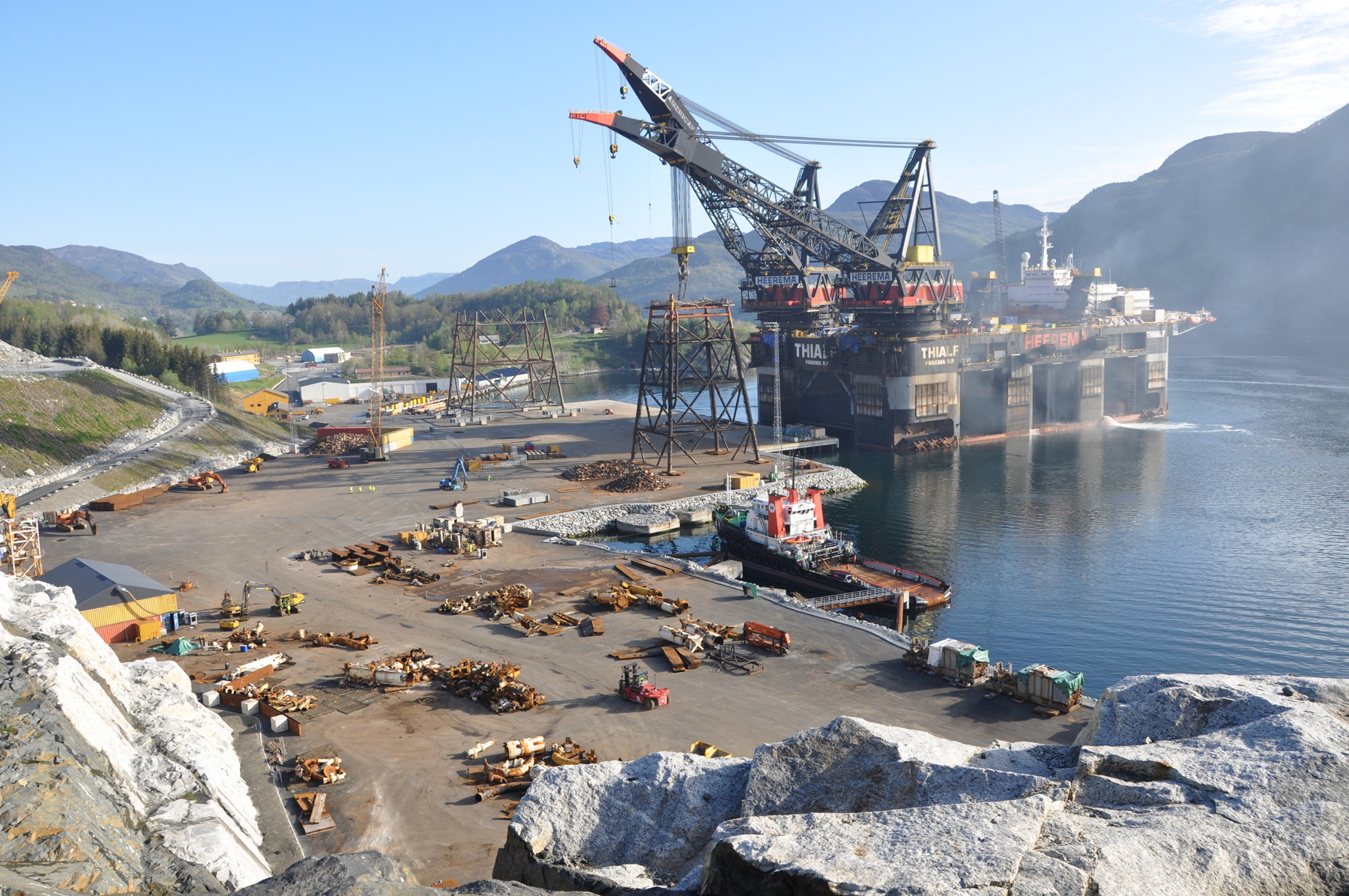
From 2009–2014, “15 platforms with flare towers, bridges and jackets from
Ekofisk, and five platforms from the British Inde field” were scrapped.[REMOVE]Fotnote: Førde, Thomas and Olsen, Knut Gjerseth 2010. På landeveien ut av
oljealderen. In: Stavanger Aftenblad Pluss, p. 21. See also on the
demolition and recycling of the Ekofisk-tanken somewhat earlier than
this period in: Sandberg, Finn Harald. Ekofisk-tanken – et ikon som blir
stående. In: https://ekofisk.industriminne.no/nb/hjem/ :
https://ekofisk.industriminne.no/nb/ekofisk-tanken-et-ikon-som-blir-staende/
Tradition, the bigger picture, and a new transformation?
Today AF Gruppen is still at Raudnes under the name AF Offshore Decom/AF
Miljøbase Vats.[REMOVE]Fotnote: AF Decom: Decommissioning – AF Gruppen , AF Miljøbase Vats: AF Miljøbase Vats – AF Gruppen The company maintains and recycles offshore installations, and
markets itself along several axes in both time and space:
“The area at AF Miljøbase Vats is also well positioned for offshore wind, with
proximity to Utsira and the Southern North Sea. The fjord’s depth and natural
shelter from wind make it very well suited for storing large structures. Vats
also has a proud industrial history, including the production of the Troll A
platform and several other North Sea installations.”[REMOVE]Fotnote: AF Miljøbase Vats: AF Miljøbase Vats – AF Gruppen
Industrial history built on geographic advantages that mattered in the oil age
still plays a role today in how companies adapted to a broader energy concept
present themselves.
Perhaps all or parts of the Gullfaks installations, on their final journey, will
find their way back to the fjord labyrinth of Nord-Rogaland to be more or less
reincarnated in forms valued by the circular economy.
In that way, Vats can increasingly represent not only the construction phase of
the oil age’s concrete-dominated installations, but the full life cycle of the
oil age.
And last but not least: the place might also help kickstart a new industrial
expansion of nature’s energy potential—just as the oil age’s concrete giants
once complemented the primary-industry perspective in the farming village of
Vats.
And what became of the silence?
Like the platforms, it turned out to be a temporary guest in Vats.