
Safety in free fall

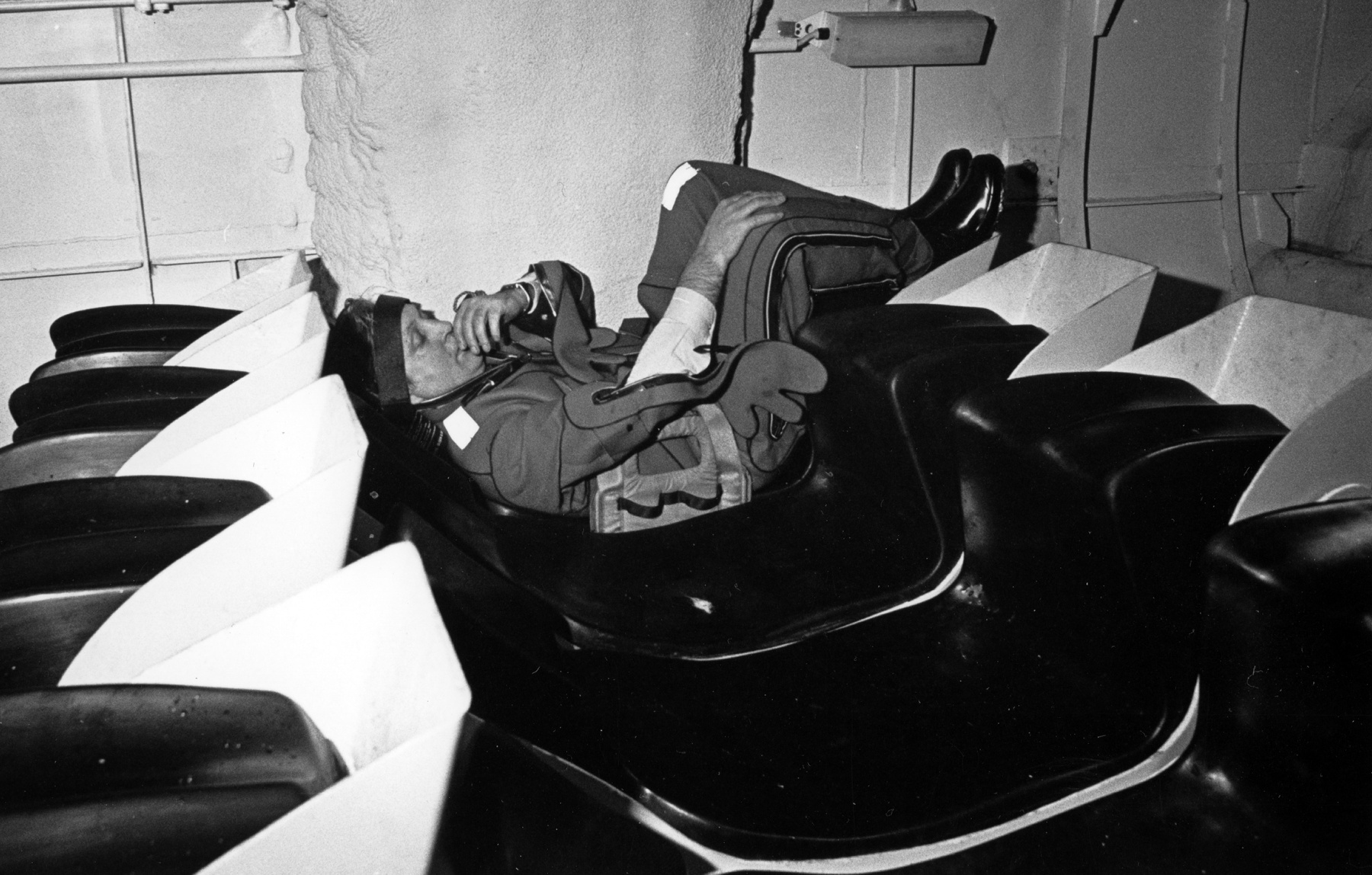
Seated with their backs to the direction of the fall, strapped in with a four-point safety harness and their heads secured to the seat with a strap across the forehead, passengers experienced a sensation of weightlessness similar to a rollercoaster ride—only much shorter. It took the boat 2.5 seconds from release to water impact. The boat’s angle was 33 degrees, and during the fall, the seats were in a horizontal position. This distributed the impact pressure evenly across the body when the boat hit the water.
Although Gullfaks A was the first production platform to adopt the innovation, the technology had already been used in other parts of the maritime industry.
The first free-fall lifeboat was installed on the bulk carrier M/S Tarcoola, owned by Wilh. Wilhelmsen. In July 1977, the lifeboat plunged 16 meters from the aft deck with 29 people on board. The enclosed lifeboat could also be released by lowering or floating off if the ship sank. During its first Atlantic crossing, several tests were conducted under various weather conditions before the new rescue system was approved by the Norwegian Maritime Directorate as the primary rescue system.[REMOVE]Fotnote: Lindesnes. (1977, 16. juli). Hele mannskapet meldte seg frivillig. This approval came in September 1978.[REMOVE]Fotnote: Bergens Tidende. (1983, 29. november). Senter for sikkerhet i Gravdal.
A Grim Backdrop
The development of the new rescue system had a grim origin. On March 22, 1973, two Norwegian ships sank off the east coast of the USA, and 61 seamen lost their lives. The dry cargo ship MS Norse Variant, built in 1965, sank off the coast of New Jersey during a storm. Only one man out of a crew of 30 survived. Not far away, the bulk carrier MS Anita disappeared in the same storm. All 32 crew members went down with the ship. Only a lifebuoy remained afloat.[REMOVE]Fotnote: Hvem-hva-hvor. (1981, vol 41). s. 320-321.
Following these catastrophic sinkings, the “Free-Fall Lifeboat” project was launched—a collaboration between Norwegian researchers, boatbuilders, and seamen to develop safer evacuation methods from large vessels, initially targeting large ships. It didn’t take long before the petroleum industry also became interested.
The blowout on Ekofisk Bravo in 1977 sparked a debate about safety on Norwegian oil and gas installations. In 1980, the research project “Safety on the Shelf” (SPS) was initiated, involving authorities, oil companies, other industries, and research institutions. One of the sub-projects focused on further developing free-fall lifeboats for use on rigs and platforms.
Several offshore accidents highlighted the need for significant improvements in evacuation safety and the challenges of traditional lifeboat lowering. During the Alexander L. Kielland disaster in 1980 and the Ocean Ranger accident in 1982, crews struggled to lower lifeboats. When rigs tilted, it was nearly impossible to release the lowering mechanisms. Fatal accidents had also occurred due to mechanism failures, causing lifeboats to drop flat onto the sea surface.
In case of fire, lifeboats could become unusable due to flames and heat. In strong winds, lifeboats could be smashed against the platform or rig structure. One goal was to develop lifeboats that could quickly distance themselves from vessels or platforms.
A Groundbreaking Innovation
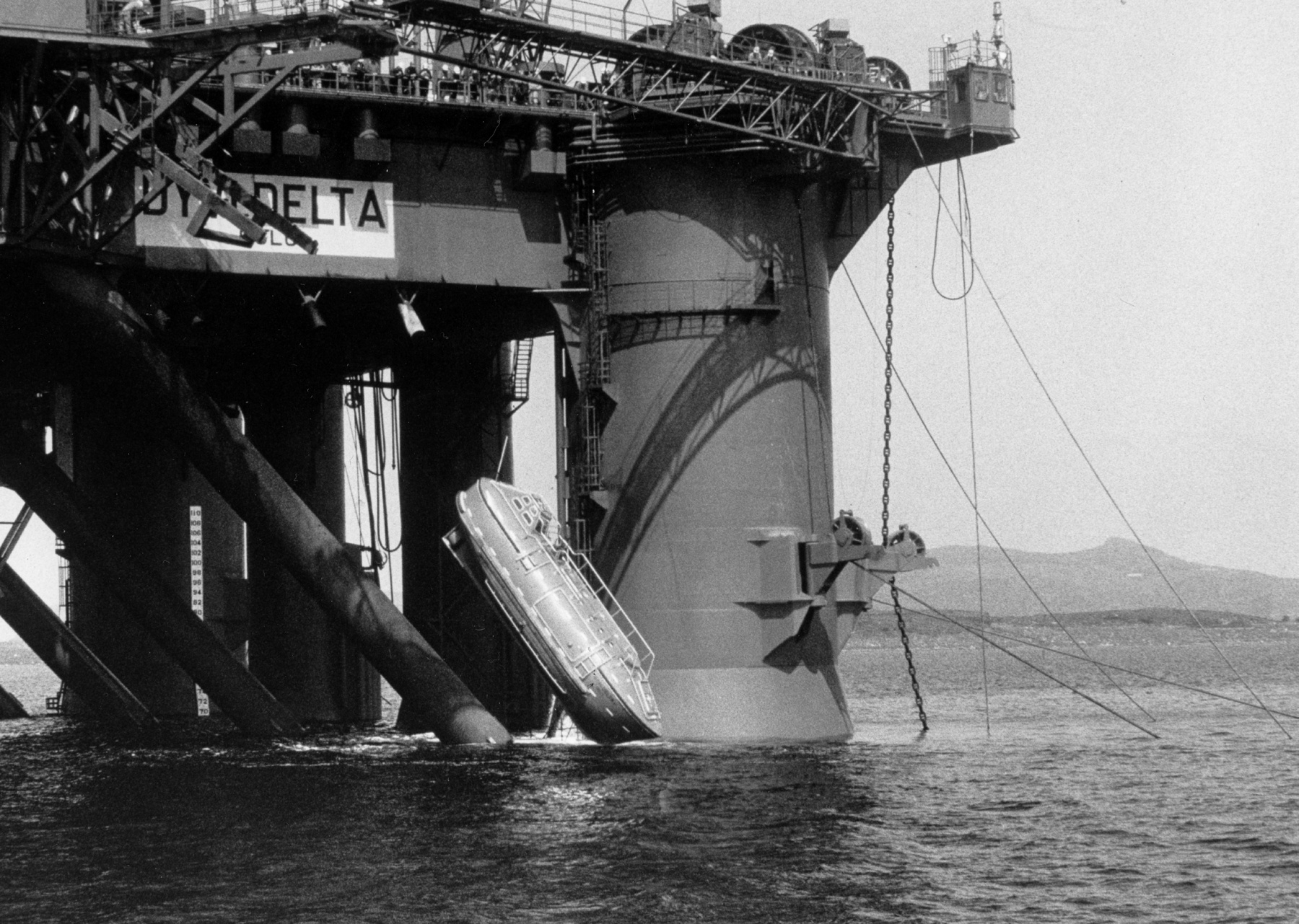
In 1981, a free-fall evacuation system was installed for the first time on a drilling rig. Dyvi Delta was then the largest of its kind in the world. Four lifeboats were sent to the Rauma-Repola shipyard and installed on the newly built rig—two forward and two aft.
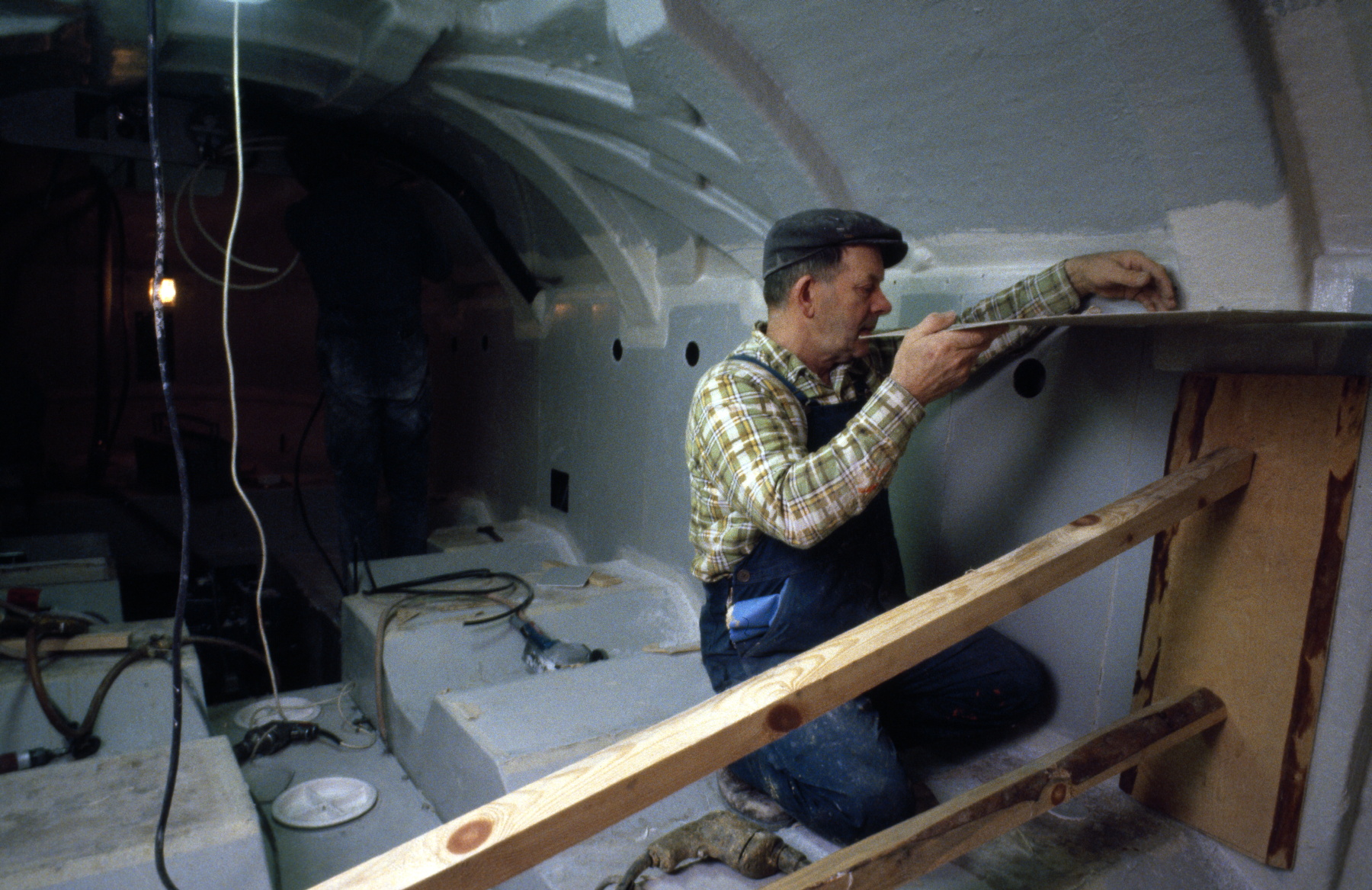
The boats were built by Harding A/S in Rosendal, a company already known for its enclosed lifeboats. The launch system was developed and built by Mjølner Industrier in Bergen. The boats could be released in free fall or lowered traditionally, depending on the situation.[REMOVE]Fotnote: Status. (1981). Vol. 3 Nr 1. s. 4. Fritt-fall-livbåt første gang på plattform.
Another free-fall boat was installed at the Maritime Schools’ training center in Trondheim, where rig crews could practice evacuation.[REMOVE]
Fotnote: Adresseavisen. (1981, 23. oktober) I denne livbåten berger man liv!
Was Gullfaks First?
During the construction of Gullfaks A, Statoil was considering which type of lifeboat would be best suited. Free-fall lifeboats were not included in the original concept report. The large steel structures required would mean several changes to the concept. However, it was still early enough in the construction process that such changes would only slightly affect progress.
To understand how the human body would react to free-fall drops, over 100 test plunges were conducted at the test facility in Trondheim, each with up to 30 people on board. After each drop, “passengers” underwent thorough psychological evaluations.
In Stavanger harbour, several drops were conducted with a new model, the FF64. First, the boat was dropped from 40 meters without passengers. Later, drops were conducted with passengers from 30 and 20 meters.[REMOVE]
Fotnote: Stavanger Aftenblad. (1982, 17. november) I kollisjon med havet.
According to Helge Hatlestad, project director Ole Børre Lilleengen concluded after discussions with the Gullfaks leadership team that if the deck project manager and HSE manager agreed to participate in a test drop, he would support the system. They accepted the challenge, and the new evacuation system was included in the Gullfaks A concept.[REMOVE]Fotnote: Helge Hatlestad. Upublisert manus. 06 Fritt fall livbåter på Gullfaks. The Maritime Directorate was more reserved and did not give its approval until spring 1983, after testing.[REMOVE]Fotnote: Helge Hatlestad. Upublisert manus. 06 Fritt fall livbåter på Gullfaks.
On November 17, 1982, the crane ship UGLEN lifted the lifeboat, loaded with sandbags, in Stavanger harbour. After a successful unmanned drop from 40 meters, the height was reduced to 30 meters for the first manned drop. Ten people were on board, including the director of the Maritime Directorate Ivar Maanum, Statoil’s safety director Kai Killerud, lifeboat project manager Per Klem, and Egil Gjesteland and Leif W. Løchen from the Gullfaks project. Three Harding employees served as captain and pump operators. The boat experienced a free fall of 2.7 seconds before hitting the water.
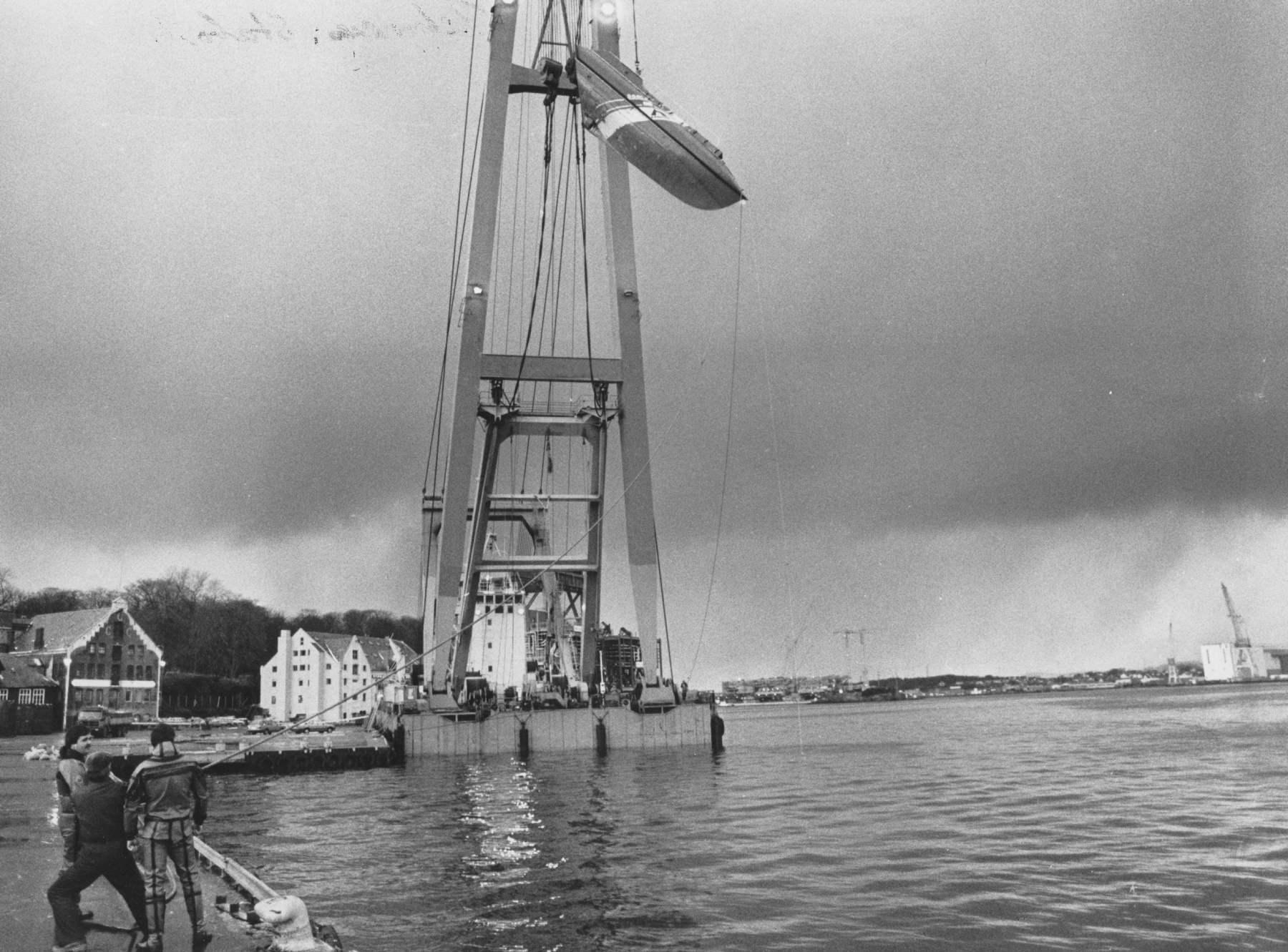
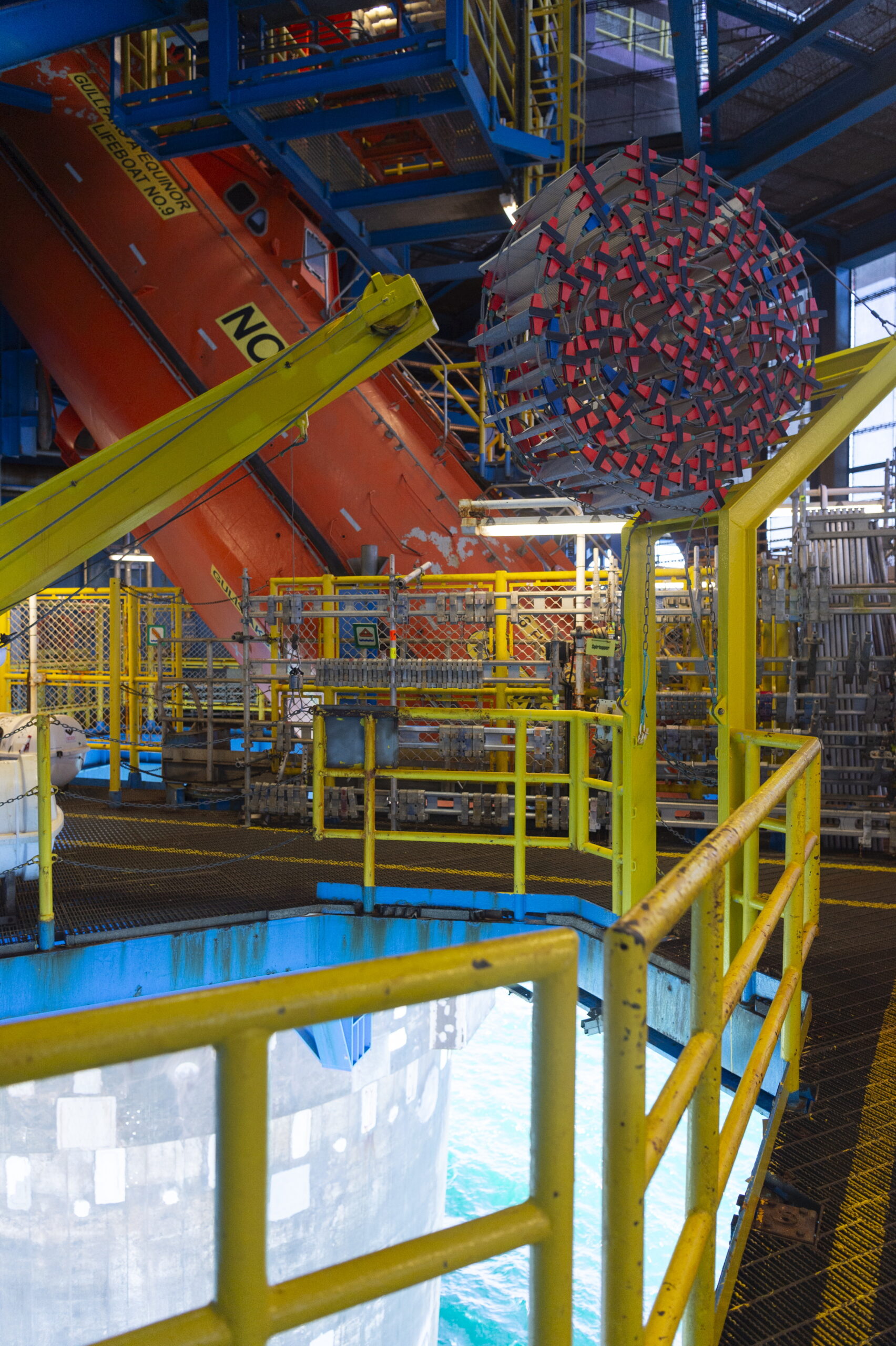
Eventually, both the Petroleum Directorate and the Maritime Directorate approved the evacuation system. Ten boats were ordered for Gullfaks A. Free-fall lifeboats became the standard on all platforms on the Norwegian continental shelf, as well as on larger vessels like cruise ships, merchant ships, and drilling rigs.
Practice Makes Perfect
The crew working on Gullfaks had to be trained in the new system. In December 1985, the first free-fall lifeboat course was held at the Norwegian Underwater Technology Center (NUTEC) training facility in Gravdal near Bergen—a company owned by Statoil, Norsk Hydro, and Saga Petroleum.
All personnel working on Gullfaks, and later other platforms, had to complete safety courses that included lifeboat muster and drop exercises. This type of evacuation could be stressful for passengers. Disaster psychiatrists estimated that 20% of the general population would react undesirably or inappropriately in a crisis. With proper training, this number could be reduced to below 5%. Therefore, realistic exercises were crucial for offshore safety.[REMOVE]Fotnote: Status. (1987, nr 7). 2300 har gjennomgått kurs i stuplivbåt.
NUTEC also changed the name of the evacuation system. Due to a few accidents and near misses at the Trondheim training center, which used older equipment and was referred to in the media as the “free-fall facility,” NUTEC wanted to avoid association. The older system used a chute-style lifeboat, the same type installed on Dyvi Delta. To avoid media criticism, NUTEC renamed the system to “Stuplivbåt” or “The Big Jumper.”
Muster drills with free-fall lifeboats remain a key part of the safety training all offshore workers must complete before boarding a platform on the Norwegian shelf. In the 2000s, questions arose about the effects of g-forces on the human body.[REMOVE]Fotnote: Stavanger Aftenblad. (2006, 26. oktober). Frykter nakkeskader av livbåt-dropp. Eventually, the actual drop was removed from the training, but dry runs of the process leading up to the drop remain central to offshore safety education.
The equipment has been further developed and improved, but the concept of increased safety through free fall remains unchanged.