
Production restrictions

In the spring of 1986, Norway received a request from OPEC (The Organization of the Petroleum Exporting Countries). The cartel sought Norway’s help in reducing global oil supply to stabilize prices at a higher level. The Willoch government firmly rejected this request. The Labour Party, however, was more open to a temporary collaboration.
In the debate over whether Norway should cut its own production to assist OPEC in raising prices, Statoil CEO Arve Johnsen sided with the Willoch government. Statoil’s opposition was cited as a possible reason why the Labour Party toned down its criticism of the government’s stance on production limits in the months that followed.[REMOVE]Fotnote: Lindøe, J. O. (1986, 27. februar). Statoil-direktøren satte Arbeiderpartiet på plass. Stavanger Aftenblad, s. 5.
Some voices in Norway advocated drastic production cuts. As early as September 1985, Øystein Nordeng, a professor at the Norwegian School of Economics, argued that Norway should use its oil production to help boost prices. He suggested delaying the opening of the Gullfaks and Oseberg fields, halting production at Ekofisk, and reducing the production from Statfjord.[REMOVE]Fotnote: Sletten, S. (1985, 20. september). Utsett Gullfaks- og Oseberg-feltet. Stavanger Aftenblad, s. 7.
Norway Joins the Effort
On May 9, 1986, Gro Harlem Brundtland formed a new government. Shortly after taking office, it became clear that Norway would “help pull the load,” despite opposition from Statoil. Initially, the government did not specify how Norway would contribute.
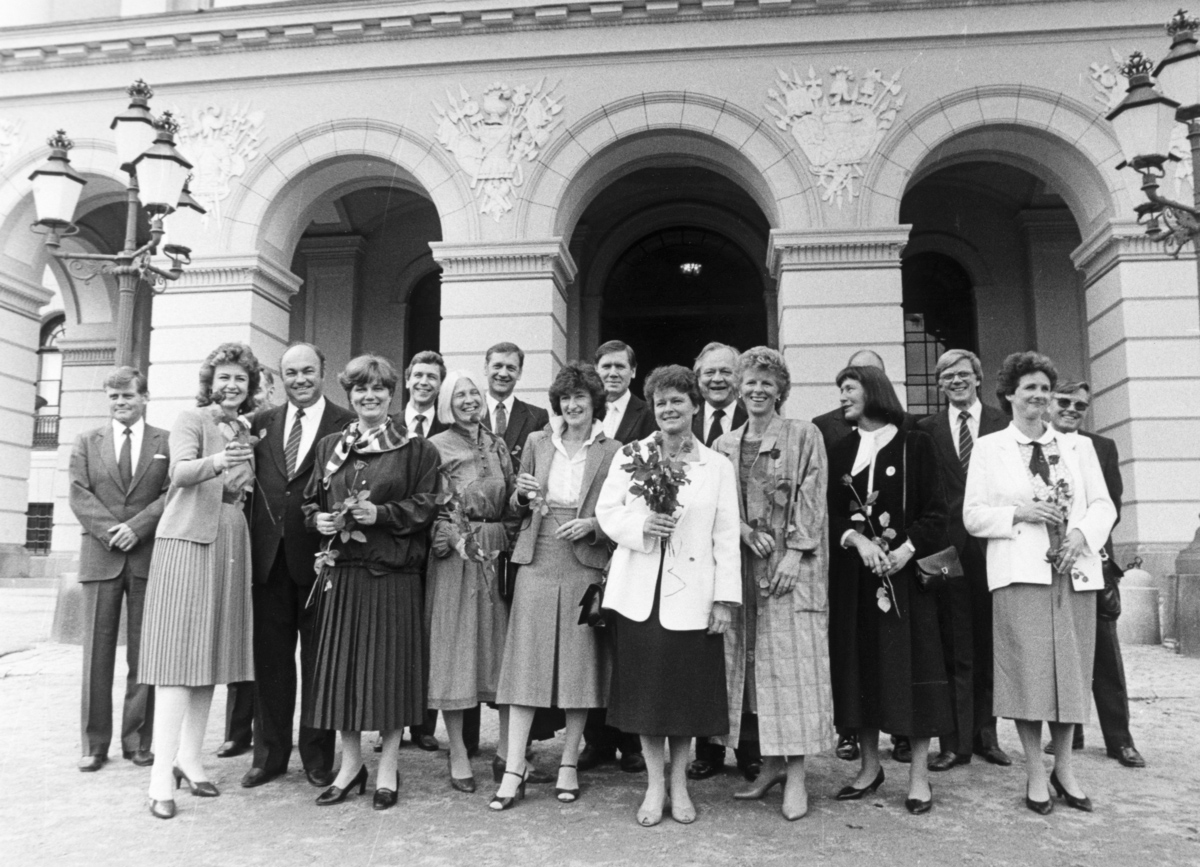
Cooperating with OPEC was highly controversial. In the fall of 1986, a public opinion poll in Norway asked whether the country should collaborate with OPEC. About half of respondents opposed such cooperation, a quarter supported it, and the remaining quarter had no opinion.[REMOVE]Fotnote: Olsen, W. (1986). God karakter i ny meningsmåling. Status: Internavis for Statoil-ansatte, (Nr. 10), s. 2.
Norway’s export restrictions effectively began in the fall of 1986. The government initially built up a strategic oil reserve equivalent to 10% of annual exports.[REMOVE]Fotnote: Lerøen, B. V. (2006). 34/10 Olje på norsk – en historie om dristighet (s. 182). Statoil. This reduced the amount of Norwegian oil entering the global market without requiring companies to cut production.
On February 1, 1987, the government went further, imposing direct production limits on the Norwegian continental shelf. Operators were ordered to reduce output by 7.5% compared to their approved production plans. The goal was to help OPEC stabilize oil prices at around $18 per barrel.[REMOVE]Fotnote: Lindøe, J. O. (1987, 27. januar). Produksjonsnedgang på 25 prosent i år. Stavanger Aftenblad, s. 7. While cutting production was not in Norway’s immediate economic interest, the country had a stake in OPEC’s success. National production cuts also held symbolic importance.
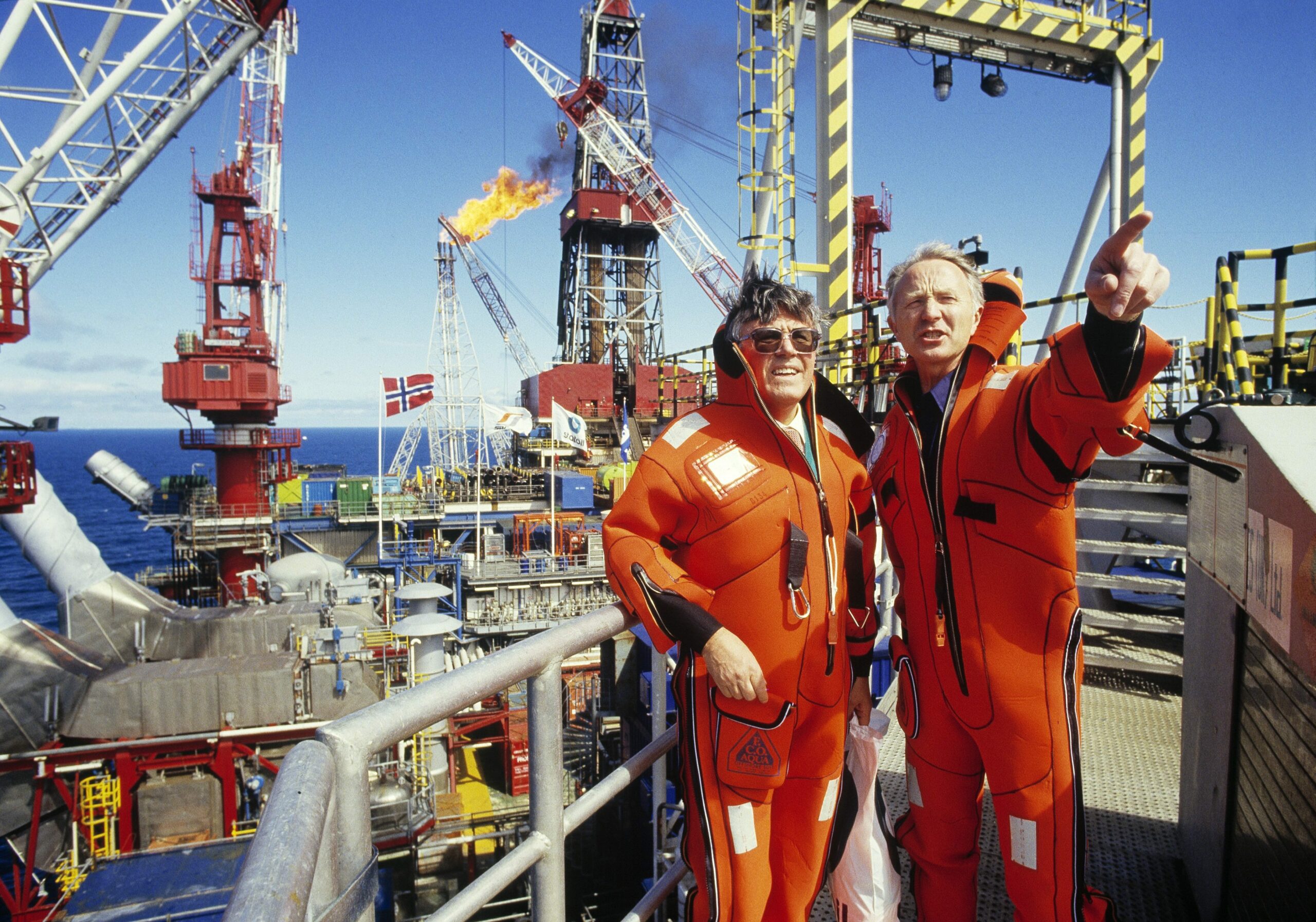
At a meeting of the Norwegian-American Chamber of Commerce on April 27, 1987, Minister of Petroleum and Energy Arne Øien stated that Norway might collaborate with OPEC on production limits for two to three years to encourage discipline within the cartel.[REMOVE]Fotnote: Lindøe, J. O. (1987, 20. juni). Olje-kutt fra 15. juli. Stavanger Aftenblad. On June 19, 1987—the same day Øien officially opened the Gullfaks A platform—the government announced that Norway would maintain its production limits through the end of the year.[REMOVE]Fotnote: Lindøe, J. O. (1987, 20. juni). Olje-kutt fra 15. juli. Stavanger Aftenblad. The 7.5% restriction remained in place until the end of 1989.[REMOVE]Fotnote: Statoil. Årsberetning og regnskap 1989. s.31. In the first half of 1990, the limit was reduced to 5%.[REMOVE]Fotnote: Statoil. Årsberetning og regnskap 1990. s.29.
Assumptions and Incentives
It is worth noting that the 7.5% production cut was based on an estimate of what would have been produced in a hypothetical scenario without restrictions. The companies’ projections of their potential production determined the scale of their mandated reductions.
In some cases, these estimates were easy for government officials to verify, particularly when companies had recently developed realistic production plans before the restrictions were introduced. In other cases, it was harder to determine how much production would have occurred without the limits.
Companies had clear financial incentives to manipulate their forecasts—either by exaggerating expected production or by reporting unrelated production challenges as part of the mandated cuts. If a reservoir turned out to be more complex than expected, reducing output, a company had an incentive to classify some of that reduction as a “voluntary production cut.”
Ensuring that all production plans accurately reflected potential output without restrictions was challenging for the government. At the same time, the state itself lacked strong economic incentives to rigorously enforce the limits. The government lost revenue due to reduced production in the form of lower taxes and dividends. Moreover, because Norway was a small player in the global oil market, its production levels had little impact on global prices.
Norway’s motivation for limiting production was not to singlehandedly drive up prices but to support OPEC’s efforts. The government wanted to help OPEC enforce discipline among its members and stabilize prices. If Norway continued producing at full capacity while OPEC members cut back, it could have undermined the cartel’s efforts. However, since Norway’s restrictions were primarily symbolic, the precise extent of the production cuts mattered less than the ability to claim that Norway was participating. As a result, the government had an incentive to take a lenient approach to verifying production forecasts.
Flexible Production Cuts
The government designed the production restrictions with flexibility. The regulations allowed some licenses to pay others to take on additional production cuts on their behalf. The goal was to ensure that Norway’s overall production declined by 7.5%, regardless of where the reductions occurred. The system functioned similarly to a carbon credit trading scheme.[REMOVE]Fotnote: European Commission. (n.d.). EU Emissions Trading System (EU ETS). Directorate-General for Climate Action. Hentet 9. oktober 2024 fra https://climate.ec.europa.eu/eu-action/eu-emissions-trading-system-eu-ets_en
This system had clear advantages. If two licenses reached an agreement where one paid the other to cut more, both parties benefited. The license accepting the additional cut received compensation, while the one purchasing the exemption paid an amount lower than the cost of reducing its own production.
In effect, this approach ensured that production cuts were made in the most cost-effective way, minimizing Norway’s overall financial losses.
Gullfaks “Cut for Two”
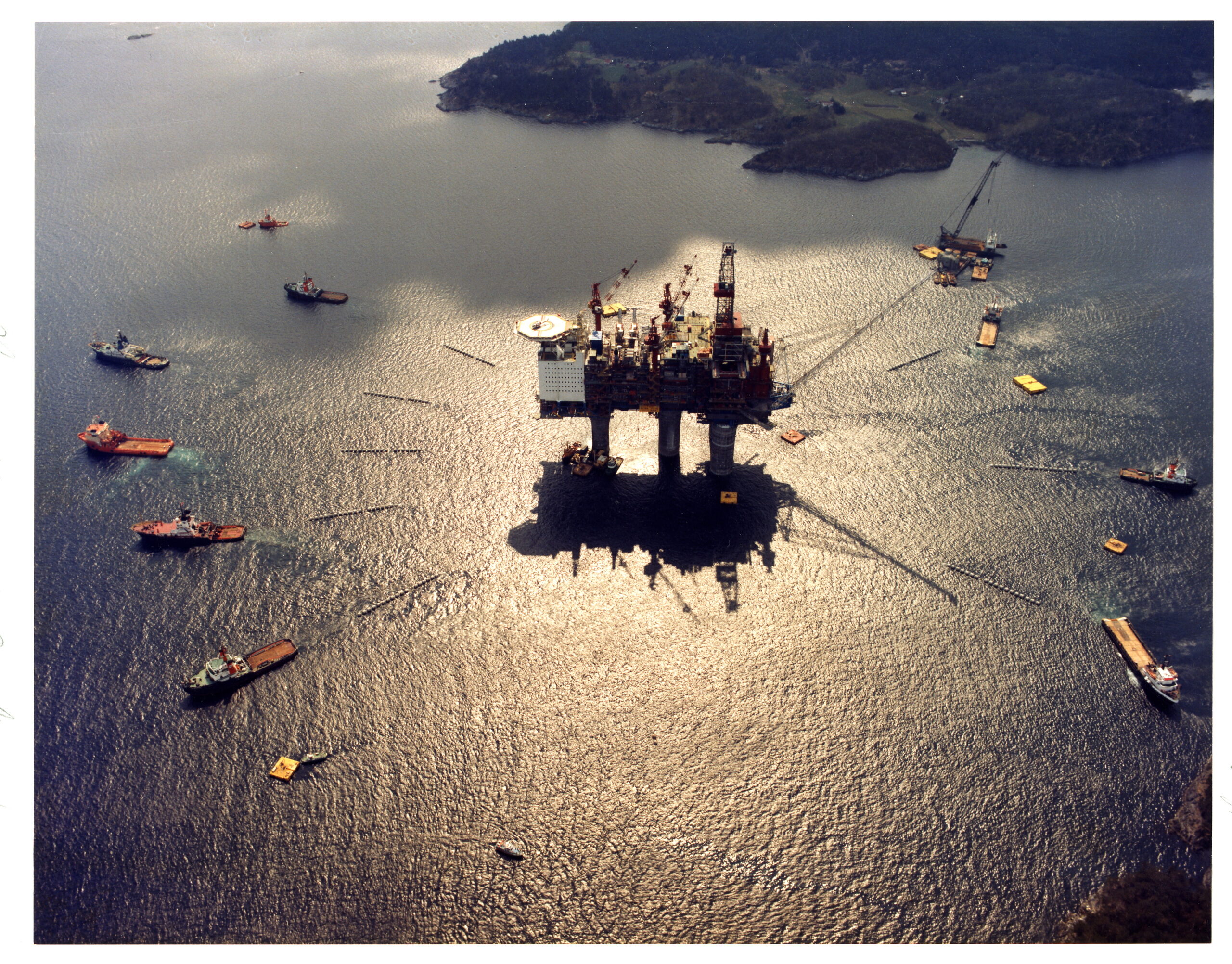
This flexibility meant that the official production restrictions had a significant impact on Gullfaks—at least on paper. In the fourth quarter of 1987, Gullfaks formally took on the production cuts for both itself and the Norwegian portion of Statfjord.
Because the government could not impose restrictions on the British sector of the Statfjord field, the Norwegian companies in the Statfjord license sought to opt out of production limits. They reached an agreement with Statoil, Hydro, and Saga (the Gullfaks license) to implement the combined reductions for both fields at Gullfaks.[REMOVE]Fotnote: Statoil. Årsberetning og regnskap 1987. s.26.
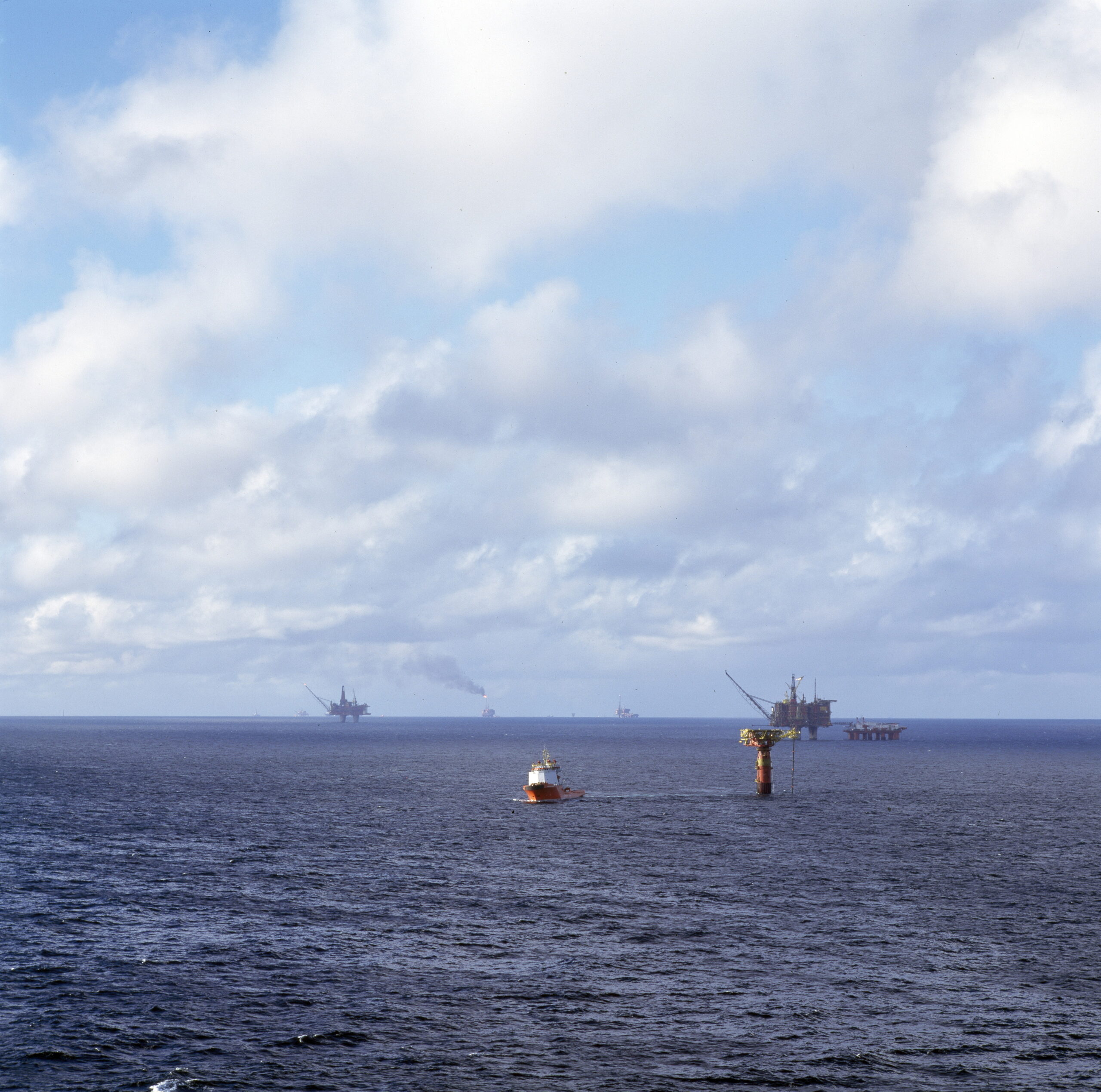
In its early years, Gullfaks struggled to meet official production forecasts. Since the reported figures formed the basis for the restrictions, Gullfaks had effectively already cut production—even while operating at full capacity. According to Kyrre Nese, then the petroleum technology manager for Statfjord, Gullfaks even had an “excess” of production restrictions that Statfjord was able to utilize.[REMOVE]Fotnote: Based on an email exchange between the Norwegian Petroleum Museum and Kyrre Nese, who was the petroleum engineering manager for Statfjord during the relevant period.
The compensation Gullfaks received for taking on additional cuts is unknown. However, since Statoil, Hydro, and Saga all agreed to the arrangement, the compensation likely exceeded the expected financial losses from delaying some of Gullfaks’ production. If companies believed that OPEC would succeed in raising prices, delaying production could also be profitable. In hindsight, oil prices rose significantly after the turn of the millennium.
Consequences of the Production Swap Agreement
The so-called “Production Swap Agreement” initially required Gullfaks to reduce output by an amount equivalent to 7.5% of the Norwegian portion of Statfjord’s production, in addition to its own mandated cuts.
Although it is unlikely that Gullfaks actually reduced production as much as reported, the scale of the reductions it claimed to implement is worth noting.
In 1987, Gullfaks had an average daily production of 70,000 barrels. The agreement remained in place throughout 1988. Due to the start-up of Gullfaks B in February, daily production averaged 150,000 barrels in 1988—even as Gullfaks officially absorbed its own and most of Statfjord’s production cuts.[REMOVE]Fotnote: Statoil. Årsberetning og regnskap 1988. s.28 The 7.5% production restriction continued through 1989, but Statoil made no mention of a production swap agreement for that year.
The figure shows Gullfaks’ actual annual production, supplemented with the production levels Statoil estimated would have occurred in a hypothetical scenario without production restrictions.
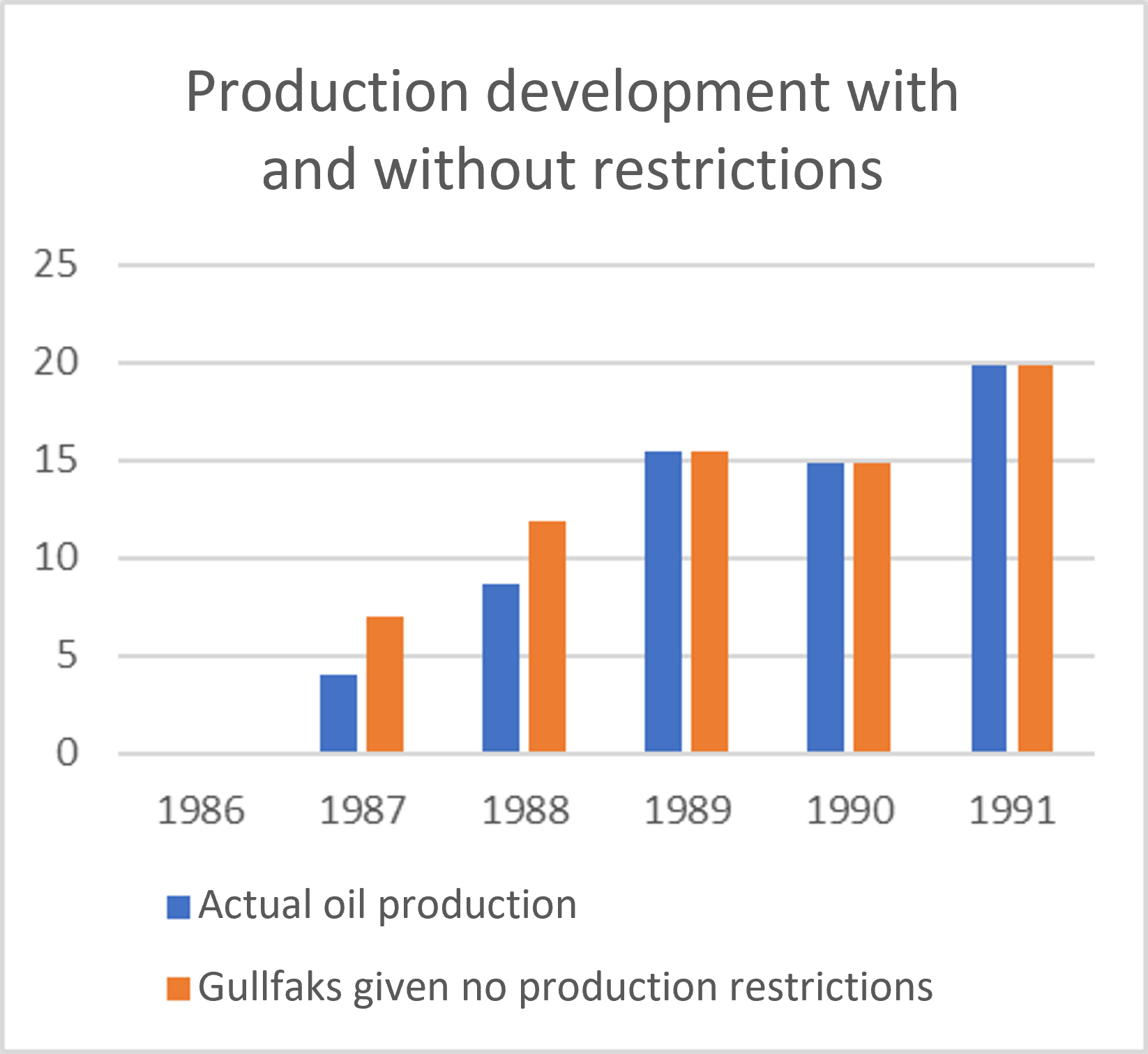
The estimated production figures in the above chart should be taken with a grain of salt. Simply put, we do not know exactly how much Gullfaks—or other fields on the Norwegian continental shelf—would have produced in a scenario where Norway had not imposed production restrictions. Production was likely lower than it would have been without limitations, but probably not by 7.5%.
On paper, Norway—and particularly the Gullfaks license—appeared to play a key role in efforts to push oil prices higher alongside major producers. In reality, the restrictions were likely modest.