
Pioneering project

The Gullfaks field is located in the Tampen area in the northern North Sea, at water depths between 130 and 220 meters. Statoil wasted no time in starting exploration drilling. Just days after the parliamentary decision, the drilling rig Ross Rig was in place, and by the end of July 1978, a discovery was announced in the first well. By the end of 1979, six exploration wells had been drilled, four of them that year. Significant quantities of oil were confirmed, and the goal was to declare the discovery commercially viable by 1980. When the viability report was submitted in November 1980, 11 wells had been drilled, and the main reservoir was sufficiently mapped to confirm commercial viability. From license award to production start in December 1986, only eight years and six months had passed. The field was still producing from all three platforms in 2023 and is expected to remain in operation for another one to two decades.
Field Development Plan
Work on the field development plan began early in 1980, led by license manager Tor Ivar Pedersen. He was joined by a team of reservoir engineers, drilling engineers, and an operations and readiness coordinator. The Technology and Development (T&D) department was responsible for the technical solution. Statoil’s experience from the Statfjord project served as a foundation, and management decided to base the development on the PDQ concept (Production, Drilling, and Quarters), meaning all essential functions would be integrated into a single platform. A major fault runs through the field from south to north, and it was decided to develop the field in two phases. Phase 1 covered the reservoir west of the fault.
After initial evaluations, it was decided that Gullfaks A would be a Condeep platform with three-stage processing and a capacity of 245,000 barrels per day. Gullfaks B would be a steel jacket platform with only first-stage separation but with high water injection capacity. Well streams from B would be transferred to A for further processing. T&D focused on concept development for the A platform, while B was explored more schematically.
On June 10, 1981, the Norwegian Parliament approved the Phase 1 development with 119 out of 148 votes. Arve Johnsen described in his book Breakthrough and Growth the immense joy he felt after the vote. In October that year, the first Brundtland government approved the development plan.
Breaking New Ground
The development of Gullfaks A was characterized by innovation, both technically and organizationally. As Statoil’s first development project, new frameworks and methodologies had to be created. Project models, procedures, safety and quality systems, contract strategies, and specifications were developed. In January 1981, Ole Børre Lilleengen was hired as project director. His priority was to establish a leadership team and prepare tender documents for the most time-critical contracts.
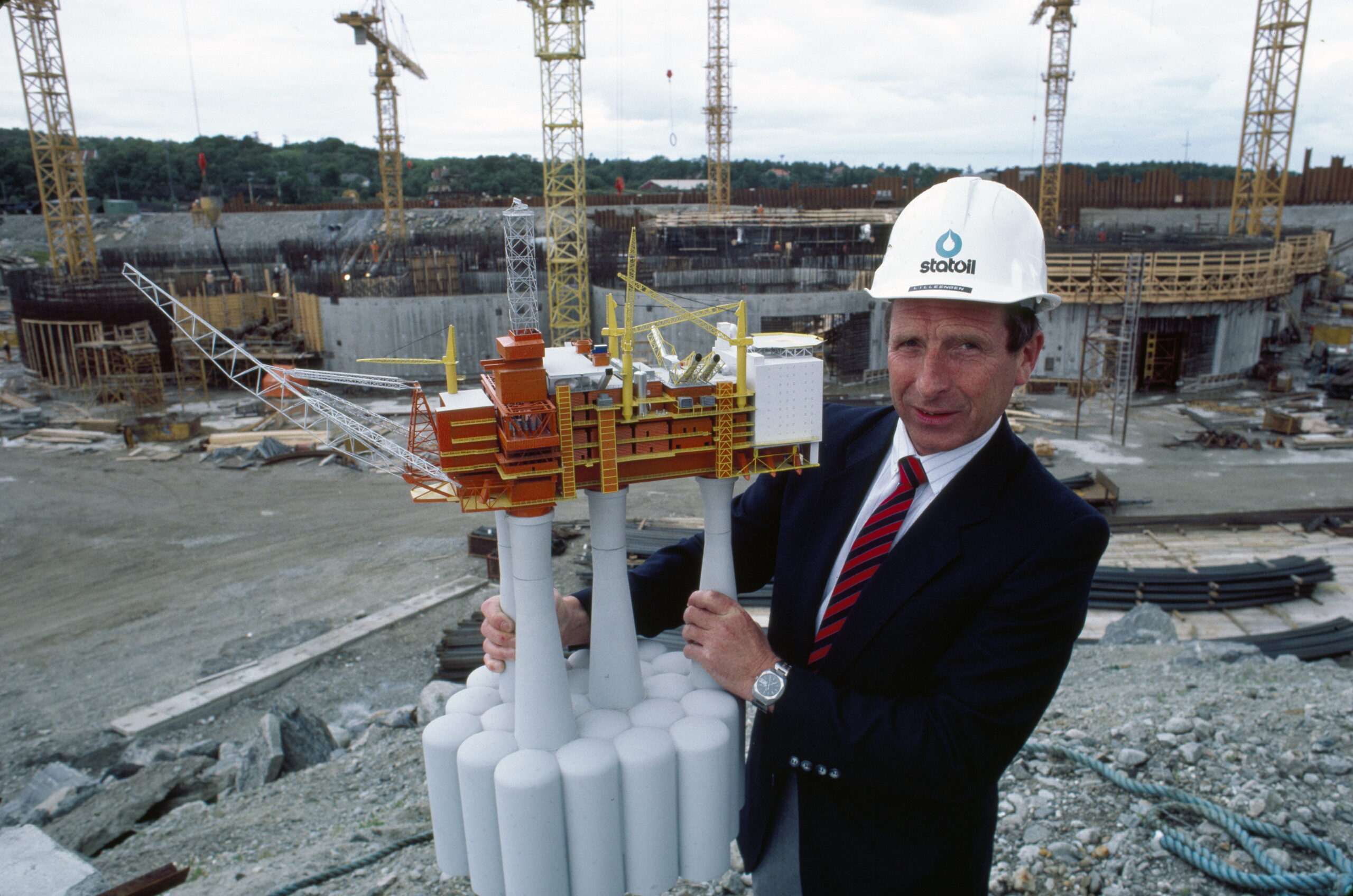
The next step was to detail the technical solutions so that suppliers and yards could submit accurate bids. Despite being a new operator with a young workforce, the project leadership chose to pursue improvements and new technologies. Innovations included a T-shaped deck structure, free-fall lifeboats, diverless subsea installations, single-occupancy cabins, computer-controlled processes, automation on the drill floor, safety systems for shallow gas pockets, unmanned loading buoys, detection systems instead of passive fire protection, stainless steel in seawater systems, and the use of heavy-lift vessels. Gullfaks A thus became a vital learning arena for future project leaders in the Norwegian oil industry – nearly 20 key personnel from the project later moved into leadership roles at Statoil, Hydro, and Saga.
Many Norwegian Suppliers
In line with the contract model, Norwegian Petroleum Consultants (NPC) was to collaborate with a foreign company as the main consultant. Bechtel was chosen, having already worked with Statoil during project preparations. Brown & Root and Foster Wheeler also participated in the bidding but were not selected. Foster Wheeler later partnered with Aker on the engineering contract.
Gullfaks A and B became the most “Norwegian” platforms to date – not only with Norwegian owners and operator, but also with Norwegian as the working language and predominantly Norwegian suppliers. As much as 80 percent of the contracts went to Norwegian companies. Norwegian Contractors received the contracts for both platforms. Aker Stord Yard handled deck assembly and mating for Gullfaks A, while Moss Rosenberg Yard did the same for Gullfaks B. The modules for the A platform were built at several locations in Norway, as well as in the Netherlands and Italy – 17 out of 21 modules were built in Norway. The operations organization was based in Bergen, with supply bases at CCB Sotra and Fjord Base in Florø.
Statoil’s Trial by Fire – How Cost-Effective Was the Gullfaks Development?
In January 1992, Statoil’s cost estimation department summarized key figures for completed projects. A comparison between Statfjord B and C and Gullfaks A and B showed that Statoil managed to continue the improvement curve from Statfjord to Gullfaks. All four platforms are located at the same water depth, and three have comparable capacity and complexity. Gullfaks B has a smaller deck but greater water injection capacity. Statfjord C saved 8–10 percent in costs by being a copy of Statfjord B.
This shows that despite its limited experience, Statoil delivered ahead of schedule and under budget – with better cost efficiency than experienced operators like Mobil. Gullfaks A and B thus became not only technological and organizational milestones but also economic success stories.