OPEC’s fading market power

OPEC (The Organization of the Petroleum Exporting Countries) is a coalition of oil-producing countries that aims—sometimes more successfully than others—to coordinate production in order to keep oil prices elevated and reduce price volatility over time. This benefits producers, at the expense of consumers.
The cartel’s central dilemma
To understand why oil prices collapsed in 1986, it is worth examining one of the structural dilemmas that a cartel like OPEC continually faces: the trade-off between maximizing short-term profits and preserving long-term market power.
If the cartel leans too far toward short-term gains by keeping production too low and driving prices too high, it creates incentives for non-OPEC producers to enter the market. Over time, this leads to a shrinking market share for OPEC, which reduces its ability to influence prices.
With diminished market power, the internal cohesion of the cartel also weakens. Cartels depend on the willingness of individual members to adhere to agreed production levels. If OPEC’s share of global supply becomes too small, member countries may no longer feel they benefit from cooperation, increasing the likelihood of members breaching production quotas. If too many go their own way, the cartel risks falling apart.
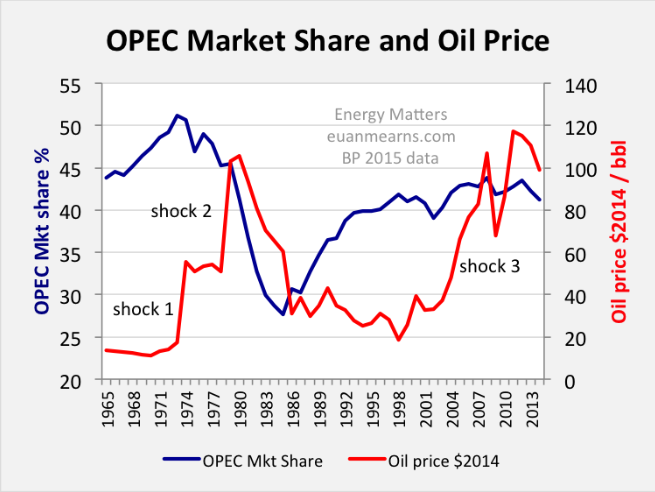
This dynamic has recurred throughout OPEC’s history. High oil prices tend to attract external competition and reduce OPEC’s market share. Low oil prices, on the other hand, help stabilize or increase it.[REMOVE]Fotnote: Mearns, E. (2015, 24. august). OPEC’s gigantic blunder. Energy Matters. Hentet frahttps://euanmearns.com/opecs-gigantic-blunder/ 18.11.2014
The price collapse of 1985–1986
The root cause of the 1985–1986 oil price collapse was OPEC’s failure to strike the right balance. The cartel had exercised too much market power for too long. Since 1982, OPEC had operated under a quota system, with Saudi Arabia assuming the role of swing producer—adjusting its output to align supply with demand.
For a time, this strategy worked. By keeping production low, OPEC managed to sustain high prices. But this also made it profitable for producers outside the cartel to develop fields that would not have been viable at lower prices. As a result, OPEC gradually lost market control, which in turn raised tensions among member countries.
Iran and Iraq, locked in the Iran–Iraq War, were eager to ramp up production to fund their military efforts. For a while, Saudi Arabia took on an outsized share of production cuts to stabilize the market.
By the summer of 1985, however, Saudi Arabia began increasing output and temporarily stepped away from its swing producer role. This move likely had a dual purpose. First, it served as a message to other OPEC members that Saudi Arabia’s special role could not be taken for granted.[REMOVE]Fotnote: Olsen, Ø. (2024). Lykkelandet: En fortelling fra innsiden av det norske oljeeventyret (1. utg.). Gyldendal. Second, it initiated a price war that made expansion less attractive for non-OPEC producers.
The production increase not only served as a form of internal discipline but also allowed OPEC to reclaim lost market share by forcing high-cost competitors out of the market. This strategy was executed on a large scale during the winter and spring of 1986.[REMOVE]Fotnote: Lerøen. B.V 34/10 Olje på norsk – En historie om dristighet. Statoil. 2006. S. 181
Is OPEC less sensitive to low prices?
Ignoring strategic concerns and market power, the main reason a low oil price matters is its impact on production in high-cost regions—those that need a high oil price to remain profitable. OPEC countries, especially Saudi Arabia, generally have large reserves and low production costs. When prices fall, high-cost producers are the first to shut down, while low-cost producers like those in OPEC remain profitable.
This means that a sustained period of low oil prices will, over time, increase OPEC’s market share. Before the price war, OPEC supplied about 30 percent of the world’s oil. Ten years later, that share had climbed to over 40.[REMOVE]Fotnote: Mearns, E. (2015, 24. august). OPEC’s gigantic blunder. Energy Matters. Hentet fra https://euanmearns.com/opecs-gigantic-blunder/ 18.11.2014
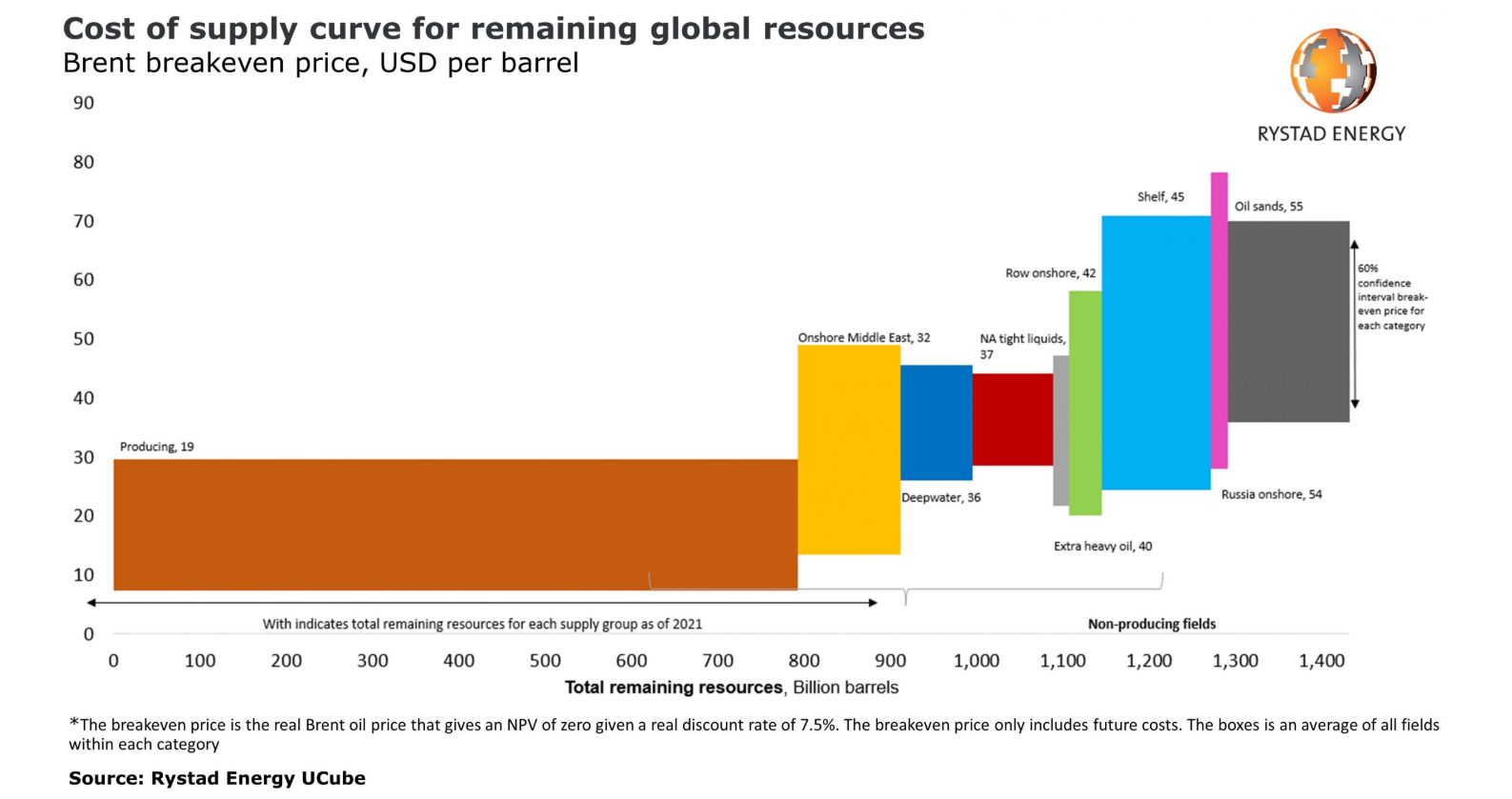
The chart below, from 2018, presents a rough cost curve for global oil production. It shows which oil sources require high prices to remain economically viable. As in the mid-1980s, onshore fields in the Middle East—primarily Saudi Arabia—are positioned at the low end of the cost curve, meaning they remain profitable even at very low prices.[REMOVE]Fotnote: Finansdepartementet. (2018). Figur 5.2 Global kostnadskurve. I NOU 2018: 17. Klimarisiko og norsk økonomi (Vedlegg 5). Regjeringen. https://www.regjeringen.no/no/dokumenter/nou-2018-17/id2622043/