
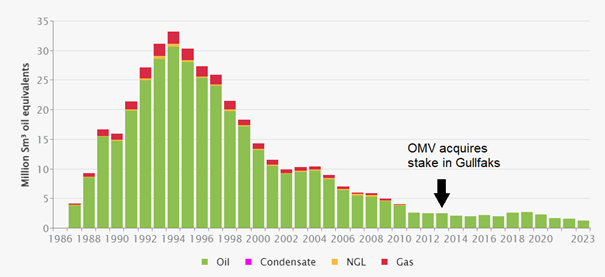
OMV acquires stake in Gullfaks

Founded in 1956, OMV is an Austrian oil and gas company with activities that also include petrochemicals. In 2013, the company operated in 16 countries and was the largest company listed on the Austrian stock exchange.
OMV established itself in Norway in 2006 and opened offices in Stavanger in 2007. In the years that followed, the company gradually increased its holdings in selected licences.
During the first years after entering Norway, OMV acquired stakes in, among others, Zidane (20 percent), Aasta Hansteen (15 percent), and Edvard Grieg (20 percent).[REMOVE]Fotnote: Øvrebek. H (29.10.13) «Går fra oljeboring i potetåkre til Arktis». Stavanger Aftenblad, s. 16. In 2013—the year OMV bought into the Gullfaks licence—the company participated in a total of 23 licences: 11 in the Barents Sea, 11 in the Norwegian Sea, and one in the North Sea.
On 31 October 2013, the company announced that it had entered into an agreement with Statoil involving the purchase of licence interests valued at USD 2.65 billion (NOK 20 billion in 2022 terms). The transaction was the largest in OMV’s history. The agreement also included a research collaboration between Statoil and OMV related to the development of technologies for increased oil recovery.[REMOVE]Fotnote: Statoil selger oljefelt for nesten 16 milliarder (tv2.no)
Under the agreement with Statoil, OMV acquired a 19 percent stake in Gullfaks and a 24 percent stake in Gudrun. As part of the same deal, OMV also acquired 30 percent of the Rosebank field and 5.88 percent of the Schiehallion field, both located on the UK side, some distance west of the Shetland Islands.[REMOVE]Fotnote: Press release from OMV 31.10.2013 OMV closes acquisition deal with Statoil
Why did OMV want into Gullfaks?
OMV’s Norway country manager, Bernhard Krainer, was interviewed by Stavanger Aftenblad on the same day the agreement with Statoil was made public. He highlighted OMV’s expertise in late-life projects as an important reason why the company now wanted to invest heavily in the North Sea.
In 2013, Gullfaks production amounted to just under 16 million barrels, corresponding to 7.7 percent of what the field had produced in its peak year of 1994. Gullfaks was thus in its tail-end production phase. To the extent that OMV possessed relevant expertise related to late-life production and enhanced recovery, this could be put to use within the Gullfaks licence.[REMOVE]Fotnote: Øvrebek. H (29.10.13) «Går fra oljeboring i potetåkre til Arktis». Stavanger Aftenblad, s. 16.
OMV CEO Gerhard Roiss also emphasized in the press release that the company wanted to invest more heavily in exploration and production in politically stable markets such as Norway and the United Kingdom.
Why did Statoil want to sell?
Another question is why Statoil wanted to sell. The short answer is that the company needed capital. After weak operating results in 2012 and 2013, it became necessary for Statoil to cut costs and raise new capital.
On 7 February 2014, CEO Helge Lund announced that investments would be reduced by NOK 30 billion over the following two years.[REMOVE]Fotnote: Senker investeringsnivået – Siste nytt – NRK The weak results added fuel to the criticism from those who believed Helge Lund should step down as CEO, and the pressure on the company was significant.[REMOVE]Fotnote: NTB Oljemilliardær mener Statoil-ledelsen bør gå. NRK 7.02.14 Mener hele Statoil-ledelsen bør gå – NRK Rogaland – Lokale nyheter, TV og radio
At the same time, it cannot be ruled out that Statoil also saw benefits in bringing new forces and new ideas into the Gullfaks licence. The need to introduce external expertise had been highlighted long before OMV entered Norway.
In the run-up to the partial privatization of Statoil and the state’s divestment in SDØE in 2001, Gullfaks had been pointed out as a field where including an international oil company could provide better governance.[REMOVE]Fotnote: Haaland. I. «Kommersialiser SDØE nå!» Dagens Næringsliv 28.09.1999 s. 3. With OMV, a foreign company finally entered the licence—but this took place 12 years later.
Gas Leak on Gullfaks BReplacing the Loading Buoys