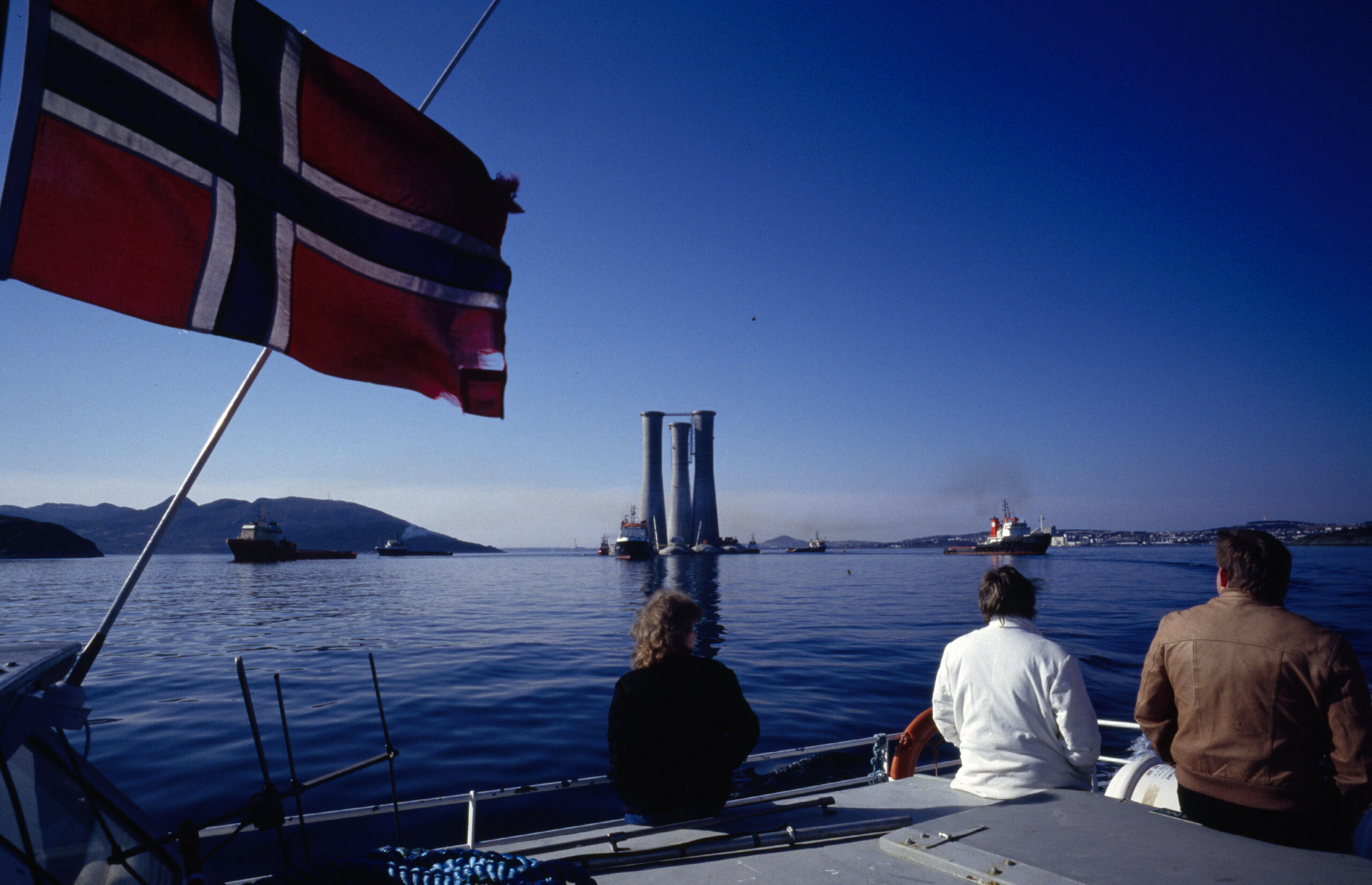
Deliveries for Gullfaks B

The total cost of Gullfaks B was estimated at around NOK 10 billion in 1985 currency. This was significantly less than Gullfaks A, which had cost NOK 16 billion, but still large enough to generate valuable contracts for suppliers across Norway.
As with previous Condeep platforms, the construction of the Gullfaks B deck was divided into multiple parts. And, as with Gullfaks A, a significant share of the contracts went to Norwegian companies.
In January 1985, three months before Moss Rosenberg Verft (MRV) signed the contract for the deck frame—the base structure of the deck—Statoil issued tenders for most of the modules. With an eight-week bidding deadline, the summer of 1985 would bring a wave of new contracts for yards and workshops across the country.
Contract Awards
By June, it was becoming clear who would build what. For Gullfaks A, about 80 percent of the contracts had gone to Norwegian companies, and it quickly became evident that Gullfaks B would follow a similar pattern.
On June 12, 1985, Statoil signed contracts worth NOK 200 million. All four drilling modules, with a combined value of NOK 155 million, were awarded to A/S Nye Fredrikstad Mekaniske Verksted. At peak activity, this work would employ between 600 and 700 workers.
Kristiansand Mekaniske Verksted was awarded the contract for the processing module, valued at NOK 43 million. This project would employ up to 170 people.
Statoil emphasized that both companies had competed against international bidders and won based on their competitive pricing and strong expertise.[REMOVE]Fotnote: NTB 13.06.1985. Moduler til Norske Verft. Stavanger Aftenblad side 24
A week later, on June 18, it was announced that Aker Verdal would construct the water injection module, weighing a total of 1,250 tons. This contract was worth NOK 50 million and would employ up to 160 workers.
The delivery deadline for all six modules was set for August 1, 1986.[REMOVE]Fotnote: 18.06.1985. Oppdrag til Aker. Stavanger Aftenblad side 6 By that time, the deck was scheduled to be floated out and ready for module lifting.
By autumn 1985, most of the major contracts for the Gullfaks B deck had been awarded. Below is an overview of the key deliveries:
Key Deliveries for Gullfaks B
Caption: The overview shows some of the key deliveries for the Gullfaks B deck and their production locations.
📖 Source: Status: Internal Magazine for Statoil Employees, 1985, No. 9, p. 12
In addition, several other suppliers received smaller and more specialized contracts. The companies responsible for the main modules could also sign subcontractor agreements. For instance, Marine Aluminium in Karmøy secured a contract with Leirvik Sveis (supplier of the living quarters module) to deliver the platform’s windows.
Other notable subcontractors included Drammen Stål, which manufactured heat pumps for the living quarters module; Terotech in Sandnes, which produced maintenance manuals for much of the platform’s equipment; and Alfsen & Gundersen, which supplied the ventilation system.
The cost difference between Gullfaks A and Gullfaks B was due to several factors, but the main reason was that Gullfaks B had fewer functions than its predecessor.
Instead of generating its own power, Gullfaks B would receive electricity via a cable from Gullfaks A, supplied by Standard Telefon og Kabelfabrikk. Additionally, it would not store oil but instead send production to Gullfaks A for processing. This gave the platform some of the characteristics of a satellite installation—an extension of the existing field infrastructure.[REMOVE]Fotnote: Status: internavis for Statoil-ansatte. 1985 Nr. 2 s. 6
Module Lifting
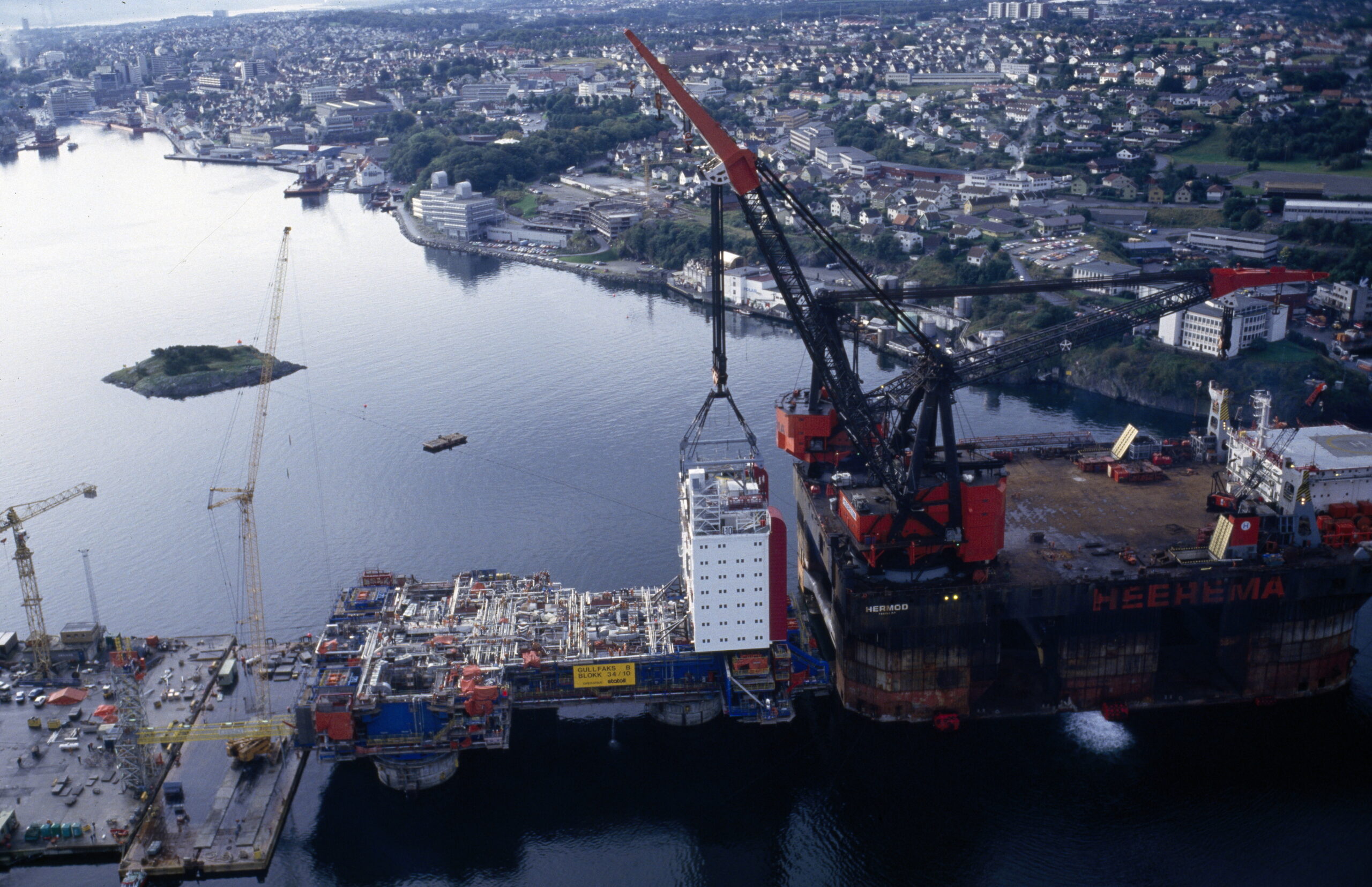
The first modules arrived at Moss Rosenberg in September 1986. By then, the deck frame was ready for module lifting and assembly. It was placed on temporary concrete legs—identical to the ones that would support the structure once it was installed on the substructure.
The process of installing and connecting the modules continued through the autumn and winter of 1987. The final module, the flare boom, was lifted into place on February 12, 1987. Positioned on the east side of the platform, the flare boom brought the total deck weight to approximately 28,000 tons.[REMOVE]Fotnote: Status: internavis for Statoil-ansatte. 1987 18. februar. S. 6
The remaining time at the yard was spent on integration and equipment installation. On April 5, 1987, an “open day” was held on the deck, allowing Statoil and Moss Rosenberg employees to bring their families to visit the nearly completed platform.[REMOVE]Fotnote: Status: internavis for Statoil-ansatte. 1987 Nr. 5. 29.april s. 6-7
On the same day, the concrete substructure, which would support the deck, departed from Gandsfjorden en route to Vats.