
Laying the groundwork: Gullfaks and Norway’s first gas corridor

The construction of Gullfaks A and B (Phase I) was approved by Parliament in connection with the discussion of White Paper No. 102 (1980-1981), “Landing of gas from the Statfjord and Heimdal fields, among others.” The case concerned the construction of a gas pipeline from Statfjord to shore and the establishment of a receiving facility for rich gas.[REMOVE]Fotnote: Rich gas refers to raw natural gas and contains a range of components such as methane, ethane, propane, butanes, and pentanes. These are transported together in the pipeline and separated at the processing facility. It was already anticipated that this facility would be located at Kårstø in Tysvær Municipality, northern Rogaland.
By allowing Gullfaks to connect to Statpipe, the pipeline could receive and transport a larger volume of rich gas. This helped justify the costs associated with the project.
Of the original recoverable resources in Gullfaks, only 5.5 percent consisted of gas. However, due to the sheer size of the field, this still represents a substantial amount. When ranking fields that had been put into production as of 2024 by their original gas reserves, Gullfaks is in 30th place. The gas reserves in Troll are more than 60 times larger. At the same time, approximately 90 fields on the Norwegian continental shelf have had smaller gas reserves than Gullfaks.
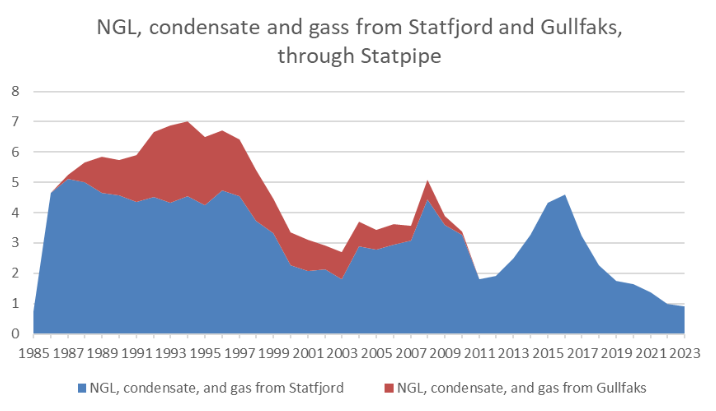
The figure below shows the volume of gas, condensate, and NGL produced from Statfjord and Gullfaks (excluding satellite fields that were later connected) – the two fields that authorities in 1981 decided could send their gas to market via Kårstø.[REMOVE]Fotnote: The figures are sourced from the Norwegian Offshore Directorate’s fact pages.
Gullfaks has contributed a significantly smaller share of the rich gas transported through Statpipe compared to Statfjord, but the volume remains substantial. In later years, several additional fields have been connected to the system, including Brage (production started in 1993) and Johan Sverdrup (production started in 2019).
Although the Heimdal field has been linked to Statpipe since the beginning, its gas enters the system at a later stage and does not pass through Kårstø.[REMOVE]Fotnote: Heimdal has delivered dry gas into Statpipe, where it mixed with gas from Statfjord and Gullfaks after first passing through Kårstø for processing. Instead, Heimdal gas is mixed with Statpipe gas along the pipeline section between Kårstø and the continent. Therefore, Heimdal is not included in the figure.
Statpipe was the first gas pipeline extending from the continental shelf to cross the Norwegian Trench on its way to an onshore facility in Norway. As such, the pipeline can be seen as fulfilling the sixth oil directive: “Petroleum from the Norwegian continental shelf should, as a general rule, be landed in Norway.”
In connection with the construction of Statpipe, co-owners from Statfjord, Gullfaks, and Heimdal established a joint transport company, I/S Statpipe.[REMOVE]Fotnote: Vatle. E (1990) Gassdrevet distriktsbygging – Samfunnsmessige virkninger av Kårstø-utbyggingen. Kommuneforlaget. s 15 Statoil was appointed as the operator for both the construction of Statpipe and the Kårstø plant, where the gas would be received, processed, and exported.
The development of the Kårstø facility and the laying of Statpipe pipelines began around the same time as the planning of Gullfaks. The Statpipe and Kårstø facilities were completed well in advance of Gullfaks starting production.
On July 25, 1985, gas from Statfjord was sent through Statpipe for the first time, and the Kårstø facility became operational. The system had therefore been in operation for nearly two years before Gullfaks A was connected in 1987.