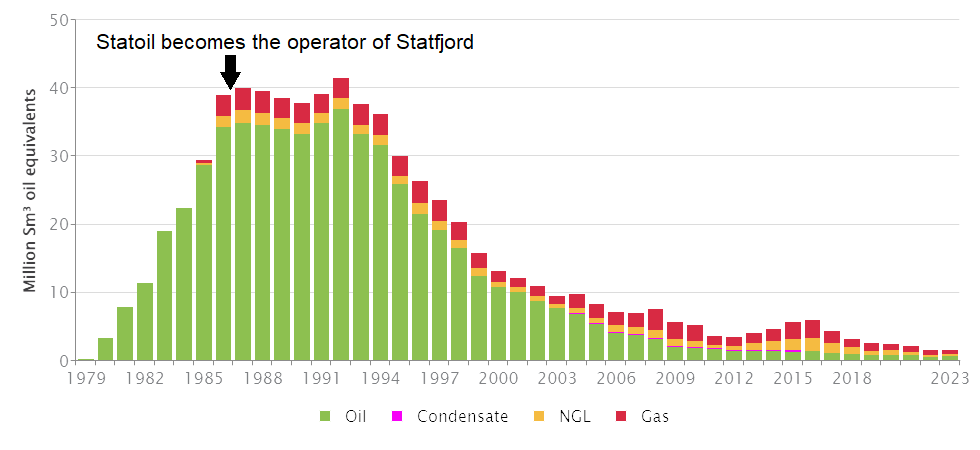
Gullfaks came onstream 10 days before Statoil took over Statfjord

Production at Gullfaks A started only ten days before operator responsibility for Norway’s largest oil field, Statfjord, was transferred from Mobil to Statoil. In the months leading up to this, the Gullfaks startup had been accelerated by several months. There was likely a degree of prestige tied to getting Gullfaks up and running before the Statfjord handover took place.[REMOVE]Fotnote: Lerøen, B. V. (2006). 34/10 Olje på norsk – En historie om dristighet. Statoil. s. 89.Statfjord had recently reached plateau production when Statoil took over in January 1987.[REMOVE]Fotnote: Platåproduksjon viser til perioden i feltets levetid hvor produksjonen er på sitt høyeste. I Statfjord sitt tilfelle mellom 1986 og 1993. Motsatsen er «haleproduksjon».
The transition involved relocating more than 1,700 employees. With the handover, Statoil assumed responsibility for a giant field — one that had been discovered, developed, and brought onstream under another company’s lead, though Statoil had been closely involved throughout the process.
There was never a guarantee that Statoil would be allowed to exercise its option to take over Mobil’s operator role for Statfjord. The incoming Willoch government suspended the entire transfer process when it took office in 1981.[REMOVE]Fotnote: Thommasen, E. (2022). Middel og mål: Statoil og Equinor 1972-2001 (s. 220). Universitetsforlaget.The Conservative Party feared that Statoil was expanding too quickly — and that the company’s rapidly growing cash flow might lead to inefficient resource use and waste of public funds. It wasn’t until the Statoil reform of 1984 — when a portion of the state’s ownership and associated revenues were separated from the operating fields into the State’s Direct Financial Interest (SDFI) — that the decision was made to award Statfjord to Statoil.[REMOVE]Fotnote: Thommasen, E. (2022). Middel og mål: Statoil og Equinor 1972-2001 (s. 221). Universitetsforlaget
By securing first oil at Gullfaks ahead of the Statfjord handover, Statoil demonstrated its ability to develop a field from the ground up and carry it all the way through to production. Statoil would have become operator of a producing field regardless — sometime during the winter of 1984–1985 — but it was symbolically significant that it was Gullfaks, not Statfjord, that marked the company’s transition into a fully operational oil producer.