
Gullfaks as a gas export centre

When Gullfaks A was developed, it was connected to Statfjord via a gas pipeline heading northeast. From Statfjord, the gas continued through the Statpipe system to the Kårstø processing plant.
Most of the gas exported from Gullfaks continued to pass through Gullfaks A even after the B and C platforms were installed. Gullfaks B has never had its own gas export pipeline and sends its production to Gullfaks A and C.
In 2001, Gullfaks C became the main connection point between the field and Statpipe. On 16 March that year, a new pipeline system—Gullfaks Gas Export—was commissioned. Gullfaks C was converted into a gas-handling platform, and early in the 2000s its export capacity was quadrupled. As a result, the original pipeline between Gullfaks and Statfjord was decommissioned.[REMOVE]Fotnote:Equinor. (2001, 19. mars). Gullfaks gasseksport åpnet. Equinor. https://www.equinor.com/no/news/archive/2001/03/19/GullfaksGasExportLineOpened
The expansion was due to increased gas production from the Gullfaks area, as a result of Phase II in the development of Gullfaks Sør. The work included four additional wells, which were ready for production in October 2001.[REMOVE]Fotnote: Åsland, Ragnar. «Gullfaks gasser i veg» i Status, oktober 2001, s. 6.
Gullfaks C at the Center
Where Gullfaks mainly consists of oil, Gullfaks Sør is made up of two-thirds gas.[REMOVE]Fotnote: This also includes NGL — natural gas liquids in liquid form. Gullfaks Sør was originally developed as a satellite to Gullfaks, but is today considered a separate field on the Norwegian Petroleum Directorate’s website. All production from Gullfaks Sør, both oil and gas, is sent to Gullfaks A and C. Because of gas production from Gullfaks Sør, the gas transport system had to be expanded, and Gullfaks C was, like Gullfaks A a few years earlier, upgraded with new modules.
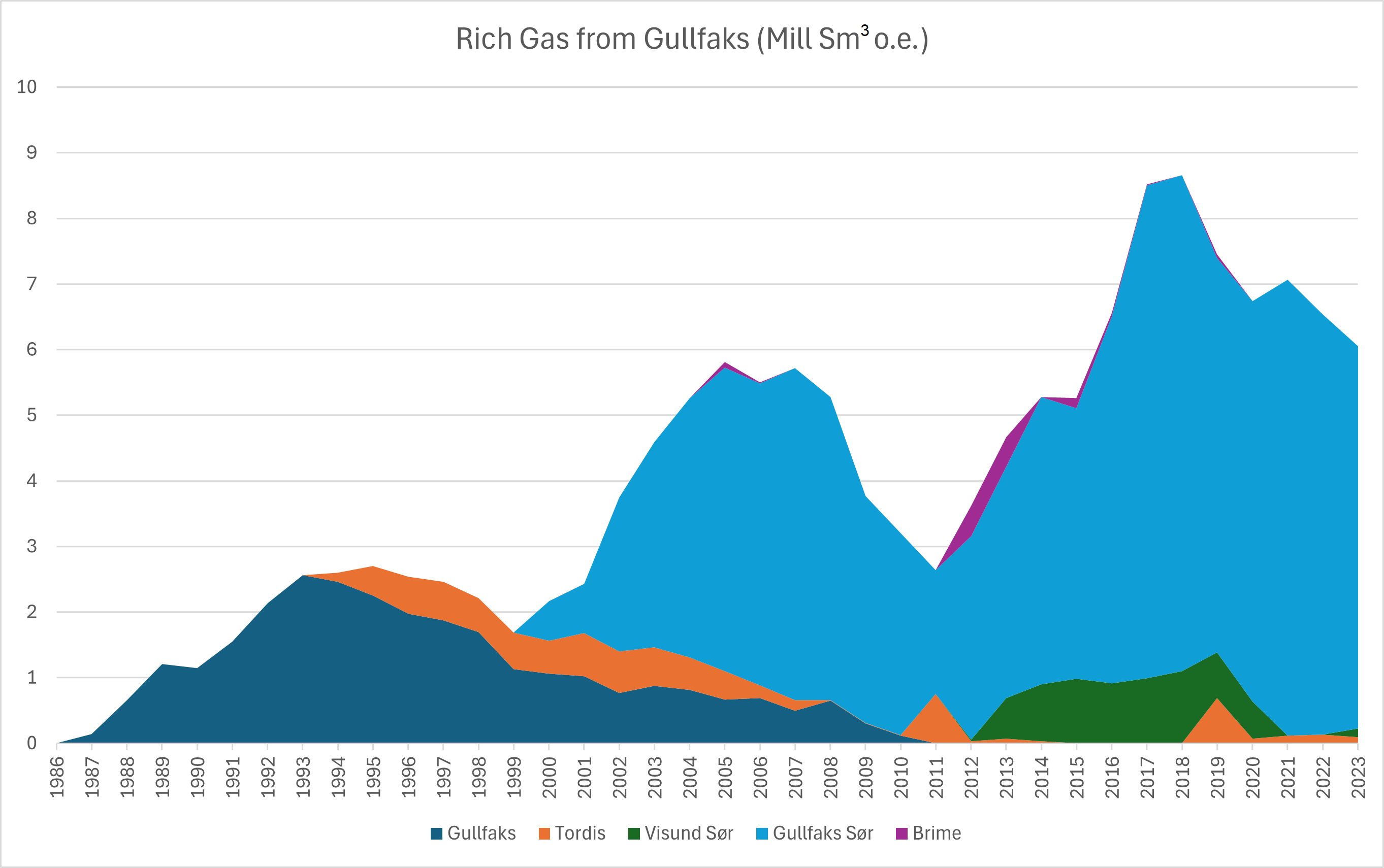
According to data from the Norwegian Offshore Directorate, Gullfaks ceased its own gas production in 2010. However, Gullfaks C continues to receive significant volumes of gas from surrounding fields. This gas is then exported via Statpipe. The contributing sources include subsea installations, nearby platforms, and wells drilled from the Gullfaks facilities that are considered part of other fields.[REMOVE]Fotnote: The classification of fields is based on the Norwegian Offshore Directorate’s website. These include Visund, Tordis, and the Brime unit (Sindre and Gimle). By far the most important contributor, however, is Gullfaks Sør, which in 2023 accounted for just over 96 percent of the gas exported from the Gullfaks platforms.
As shown in the figure, gas volumes exported from Gullfaks to Statpipe increased dramatically in the years following 2001.
From Tampen to Kårstø
On its journey toward Kårstø, rich gas from Gullfaks is joined by volumes from two other fields. Brage (production start in 1993) and Johan Sverdrup (production start in 2019) each have a pipeline connection to Statpipe. Like Gullfaks, both are primarily oil fields.
The Statpipe line to Kårstø is also used by fields outside the Tampen area. At the same time, some Tampen fields rely on other export routes. In addition to being connected to Statpipe, Statfjord is tied to the UK sector via the Tampen Link pipeline.
The Visund and Kvitebjørn fields, which are also part of the Tampen area, send their gas to Kollsnes in Hordaland through the Kvitebjørn pipeline.
Thanks to its role as a central hub for multiple Tampen fields, the Gullfaks facilities are among the largest contributors of gas to the Statpipe system heading toward Kårstø.
Gullfaks from Saga to StatoilGullfaks from the SDFI to Statoil and Petoro