
Fields delivering to Gullfaks

Tampen refers to the northern part of the North Sea and usually denotes the cluster of oil and gas fields located near one another, sharing infrastructure such as export pipelines. Coordinated infrastructure in the area has enabled the development of smaller fields that would not have been profitable on their own. Tampen also includes fields using other transport systems than Gullfaks, and this article does not cover all of them. The area extends into the UK sector as well, for example with the Murchison field.[REMOVE]Fotnote: Askheim, Svein. (n.d.). Tampenområdet. Store norske leksikon. Hentet 9. oktober 2024 fra https://snl.no/Tampenomr%C3%A5det
Gullfaks as a hub
The distinction between fields, satellites, and reservoirs is not always clear-cut, and definitions may vary. This article follows the classification used by the Norwegian Offshore Directorate, where Gullfaks Sør is considered a separate field—even if it may be seen as a satellite of Gullfaks.
Fields in the Tampen area are closely integrated and benefit from shared infrastructure. Gullfaks plays a key role in this system. It consists of three integrated concrete platforms for processing, drilling, and accommodation, along with a loading buoy. This setup makes Gullfaks well suited to receive, process, store, and export petroleum from surrounding fields. Gullfaks is also connected to the Statpipe gas pipeline leading to the Kårstø processing plant in Rogaland.
Several fields route part or all of their production to Gullfaks: Gullfaks Sør, Snorre, Vigdis, Tordis, Visund, Visund Sør, and Brime (a unit comprising Gimle and Sindre).
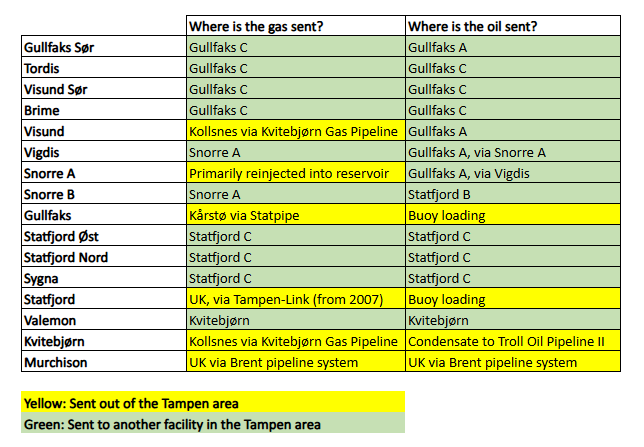
Furthermore, a brief introduction to the fields that send their production in whole or in part to one of the Gullfaks platforms follows.
Gullfaks Sør
The Plan for Development and Operation (PDO) for Gullfaks Sør was approved in 1996, and production began in 1998. As of 2025, 13 subsea templates have been installed and connected to either Gullfaks A or C, remotely operated from Gullfaks. In addition to the Gullfaks Sør reservoir, the area includes Rimfaks, Gullveig, Gulltopp, Skinfaks, Rutil, and Opdal.
Key PDO milestones:
- Phase I (1996): Gullfaks Sør, Rimfaks, and Gullveig
- Phase II (1998): Gas reservoir (Brent Group)
- 2004: Gulltopp added
- 2005: IOR project for Rimfaks + Skinfaks development
- 2015: PDO approved for Rutil and Opdal
Oil is routed to Gullfaks A for processing and loading. Gas is processed at Gullfaks C and sent via Statpipe to Kårstø.[REMOVE]Fotnote: Sokkeldirektoratet. (n.d.). Gullfaks Sør. Hentet 9. oktober 2024 fra https://www.norskpetroleum.no/fakta/felt/gullfaks-sor/
Snorre A
Snorre A began production on 3 August 1992 and is a floating drilling, production, and accommodation platform. The field was originally operated by Saga. The platform is anchored to the seabed using tension legs. Snorre is located at a water depth of 300–350 meters.
Snorre A is equipped to separate oil and gas. The oil is processed on Snorre A and exported via the Vigdis field to Gullfaks A. Most of the gas from Snorre A is reinjected into the reservoir. Snorre B began production in 2001 and exports to Statfjord B, where the oil is loaded onto tankers.[REMOVE]Fotnote: Sokkeldirektoratet. (n.d.). Snorre. Hentet 9. oktober 2024 fra https://www.norskpetroleum.no/fakta/felt/snorre/
Vigdis
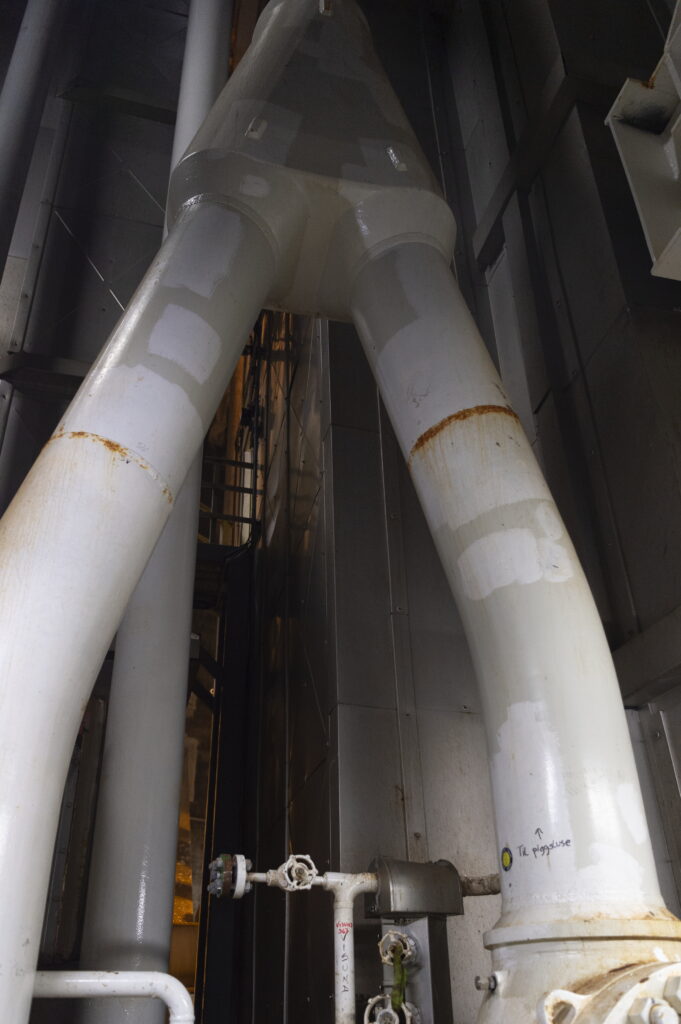
The Vigdis field began production on 28 January 1997. It is connected to Snorre A. Oil from Vigdis is processed on Snorre A, then sent back to Vigdis and onward to Gullfaks A. Gas from Vigdis is injected into the Snorre reservoir together with gas from Snorre A.[REMOVE]Fotnote: Sokkeldirektoratet. (n.d.). Vigdis. Hentet 9. oktober 2024 fra https://www.norskpetroleum.no/fakta/felt/vigdis/
Tordis
The Tordis field was discovered in 1987 and received approval for its Plan for Development and Operation (PDO) in 1991, with Saga as the operator. Production began on 3 June 1994. The wells from Tordis are routed directly to Gullfaks C for processing. From there, the oil is loaded onto tankers, while the gas is exported via Statpipe to Kårstø, together with the rest of the production from Gullfaks.[REMOVE]Fotnote: Sokkeldirektoratet. (n.d.). Tordis. Hentet 9. oktober 2024 fra https://www.norskpetroleum.no/fakta/felt/tordis/
Visund
The Visund field was discovered in 1986 and received approval for its Plan for Development and Operation (PDO) in 1996, with Hydro as the operator. Production started on 24 April 1999. The field is developed with a semi-submersible integrated accommodation, drilling, and processing facility (Visund A) and two subsea installations in the northern part of the field. After processing on Visund A, the oil is transported by pipeline to Gullfaks A.
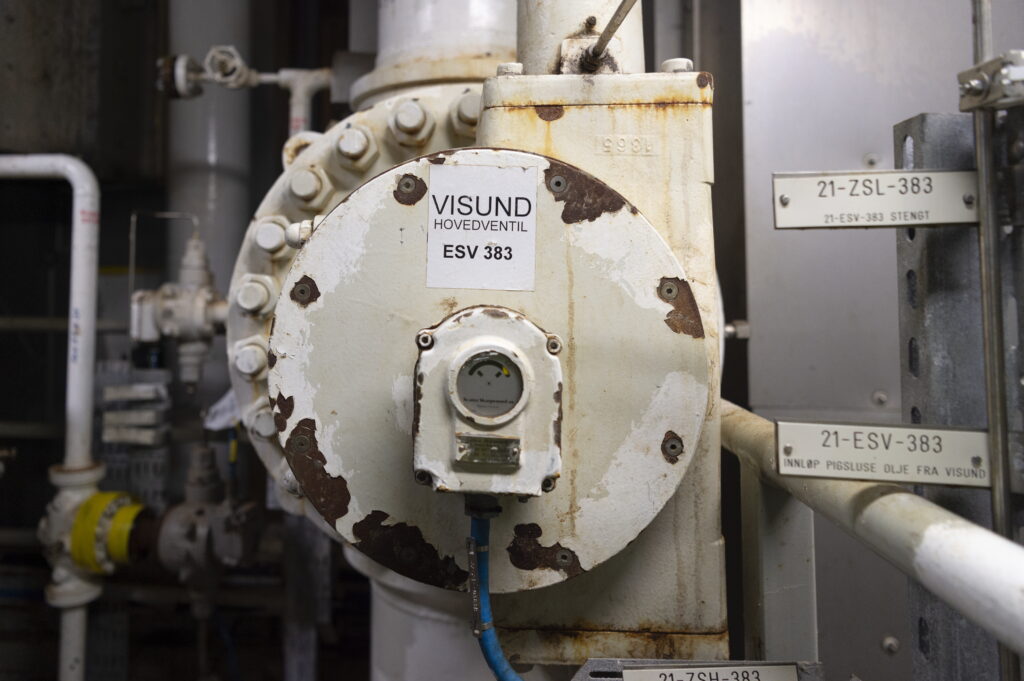
The gas is exported via the Kvitebjørn gas pipeline to the Kollsnes terminal.[REMOVE]Fotnote: Sokkeldirektoratet. (n.d.). Visund. Hentet 9. oktober 2024 fra https://www.norskpetroleum.no/fakta/felt/visund/ In other words, Visund uses a different gas transport system than Gullfaks. While Gullfaks sends its gas through Statpipe to Kårstø, Visund gas is transported via the Kvitebjørn pipeline to Kollsnes, north of Bergen.
Visund Sør
Visund Sør is an oil and gas field discovered in 2008 and approved for development in 2011. Statoil, later Equinor, has been the operator and majority owner of the license throughout the field’s lifetime. Production began on 22 November 2012, and the development consists of a single subsea template. Both oil and gas from Visund Sør are sent directly to Gullfaks C, located about ten kilometres southwest of the field.[REMOVE]Fotnote: Sokkeldirektoratet. (n.d.). Visund Sør. Hentet 9. oktober 2024 fra https://www.norskpetroleum.no/fakta/felt/visund-sor/
Gimle og Sindre (Brime)
The oil and gas accumulations in the Gimle and Sindre fields extend into each other (their reservoirs overlap), and are therefore considered a single unit. The fields are subject to a unitisation agreement, meaning the license holders of each field have agreed on how to share the resources. Gimle and Sindre together form a unit called Brime, which is owned by Equinor (74.66 percent) and Petoro (25.34 percent).
Gimle began production on 19 May 2006 and consists of three production wells and one water injection well. All wells are drilled from Gullfaks C. As a result, the entire production from Gimle is routed to Gullfaks C for processing and export.[REMOVE]
Fotnote: Sokkeldirektoratet. (n.d.). Gimle. Hentet 9. oktober 2024 fra https://www.norskpetroleum.no/fakta/felt/gimle/
Sindre consists of a single production well, which is also drilled from Gullfaks C. The field began production on 26 May 2017.[REMOVE]Fotnote: Sokkeldirektoratet. (n.d.). Sindre. Hentet 9. oktober 2024 fra https://www.norskpetroleum.no/fakta/felt/sindre/
Production volumes at a glance
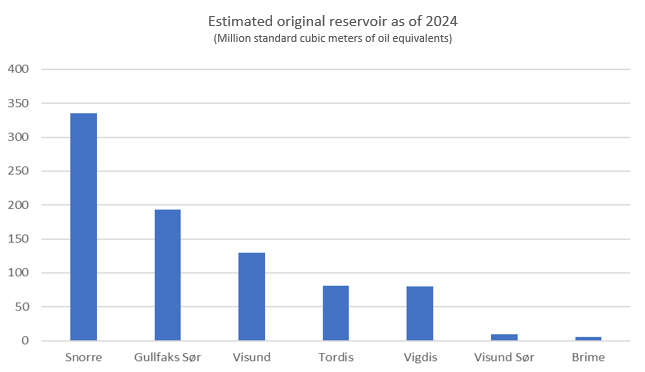
The bars show the Norwegian Offshore Directorate’s estimates of the original recoverable resources in the reservoirs of the various fields that have delivered oil or gas to Gullfaks, measured in million standard cubic metres of oil equivalent. The Snorre field is by far the largest, although much of its production is exported to Statfjord rather than Gullfaks. Brime, which includes Gimle and Sindre, is the smallest, with an estimated 5.4 million standard cubic metres of oil equivalent.
The figure below shows the annual production from all fields that deliver oil and/or gas to Gullfaks. For comparison, Gullfaks’s own production is also included. Note that the figure does not show how much oil and gas has been exported from Gullfaks. Snorre A, Vigdis, and Visund have only sent oil to Gullfaks, while Snorre B has sent its oil to Statfjord.
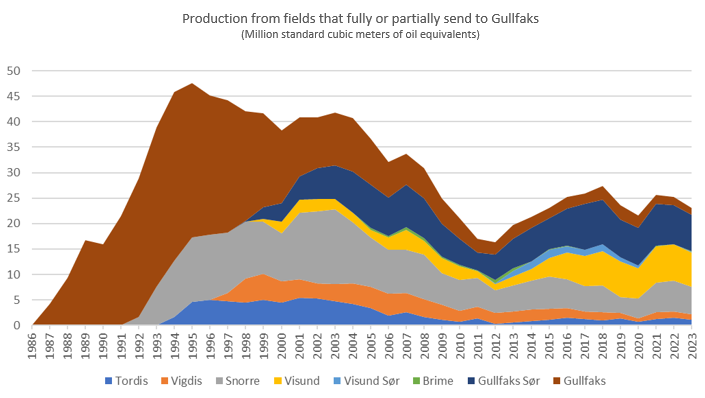
As of 2023, these fields have produced 65 percent more than Gullfaks itself. By 2025, the majority of the oil and gas exported from Gullfaks will therefore originate from other fields. These fields—both those operated from Gullfaks and those operated independently but sending their production to Gullfaks for processing and storage—help extend the operational life of the Gullfaks platforms. The many surrounding fields allow the original Gullfaks installations to remain profitable, even with a very low level of production from the original field itself.