
Contract strategy and Norwegian value creation

The water depth at Gullfaks was similar to that at Statfjord, and Statoil therefore considered a fixed platform to be the best and most cost-effective solution. The concept for Gullfaks A was largely based on experience from Statfjord, featuring a concrete gravity base structure and a steel topside carrying modules for drilling, processing, and accommodation.
To identify the best solution, Statoil organized a design competition between Aker and Kværner Engineering. Aker proposed a T-shaped deck based on shipbuilding technology, while Kværner presented a more traditional rectangular deck with a truss structure. Aker Engineering, in collaboration with Foster Wheeler, won the engineering services contract. The T-deck offered better separation between the living quarters and drilling area, easier module lifting, and could be built using familiar shipbuilding techniques. Aker Stord, with experience from supertanker construction, was awarded the deck construction contract.
Statoil’s contract strategy was clear: use proven solutions but improve them where possible, adapt contracts to Norwegian yard practices, and ensure that modules could be built and transported efficiently. Emphasis was placed on large modules to reduce hookup time, but within the lifting capacity of available vessels. EPC contracts were used where suppliers had the necessary expertise, and all contractors were required to follow internal control principles.
An EPC contract (Engineering, Procurement, Construction) means that one company is responsible for the entire delivery – from design and procurement to construction. The client deals with a single supplier, providing better oversight and reduced risk.
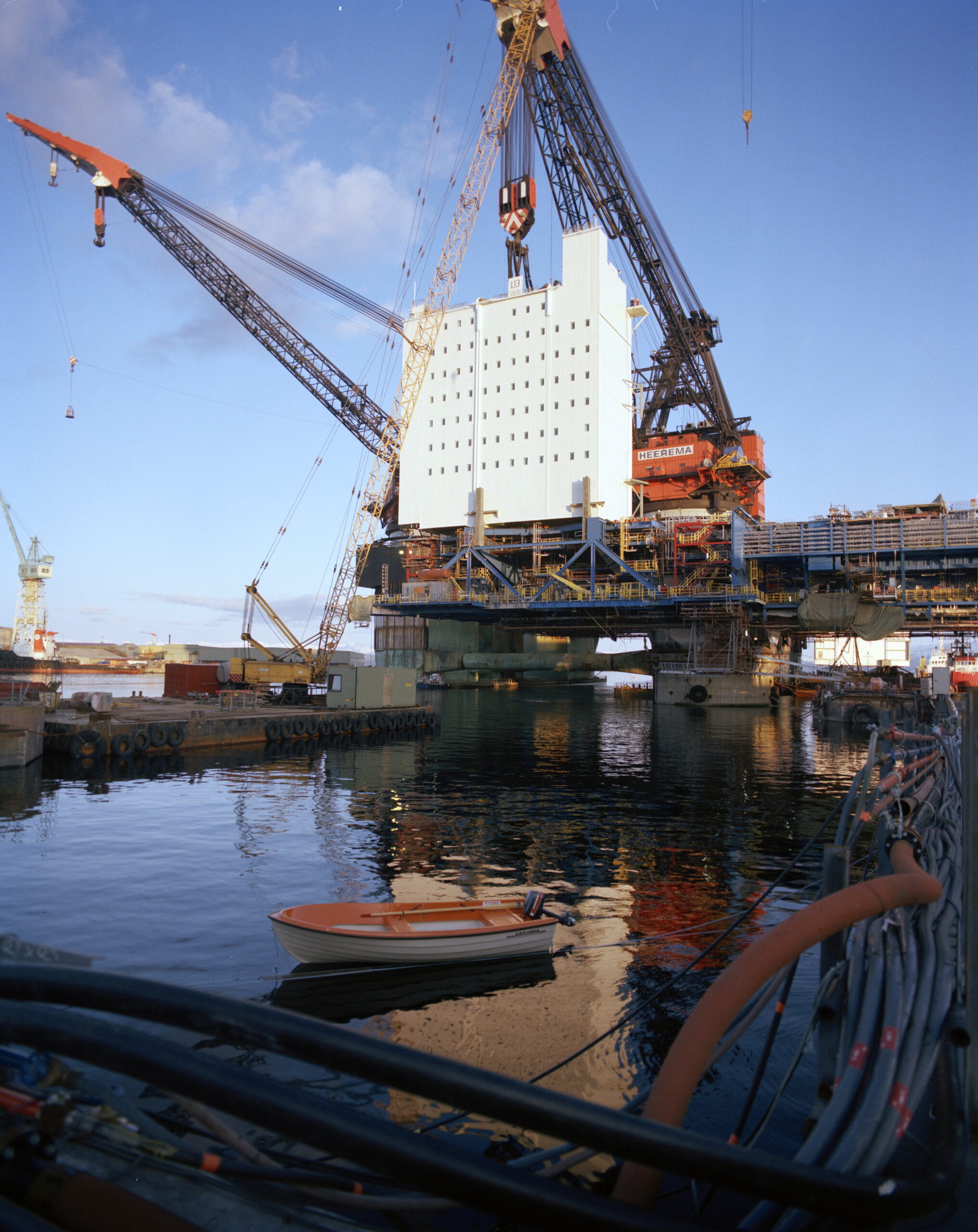
The result of this strategy was that 17 out of 21 modules were built in Norway. The concrete base structure was delivered by Norwegian Contractors using their Condeep design, and the contract also included towing to Stord, mating with the topside, towing to the field, and installation. Kværner Rosenberg received the EPC contract for outfitting the shafts. All deliveries were completed on time.
The modules were built with a high degree of completion onshore – something new in the Norwegian offshore context. Several were transported using heavy-lift vessels, a new method that made transport both faster and safer. These vessels could be ballasted so the main deck submerged, allowing the modules to be floated over the deck before the vessel was raised again. The modules were lifted into place over five days, starting on March 17 – six weeks ahead of schedule.
The largest module, D11, weighed 2,400 tonnes and was built at Bergens Mekaniske Verksted (BMV). To strengthen Norwegian industry, engineering work was transferred from NRC in Kristiansand to BMV. During construction, BMV went bankrupt, creating great uncertainty. After political pressure and efforts from the workforce, the yard was taken over and the module completed on time – including testing of the power station. Other modules were also tested before delivery, and the degree of completion before assembly had never been higher in a Norwegian offshore project.
The living quarters, also an EPC contract, were built at Lervik Sveis and delivered fully tested. Several factors contributed to the success of Gullfaks A: contracts were quickly renegotiated when drawings were incomplete, Aker Engineering’s steel expertise ensured early delivery of drawings and materials, and engineers were sent to construction sites to maintain progress in piping and detailed design. Site managers were authorized to approve changes up to NOK 5 million, enabling faster decisions and better workflow. The project leadership also allowed room for mistakes – everyone had a “blunder quota,” which fostered trust and enthusiasm.
Sources:
Speech by Jan Vesterkjær at the 33rd anniversary of Gullfaks A
Hatlestad, H. (2021). Femti år med oljeproduksjon. Min historie. Self-published.