
Accurate forecasts?

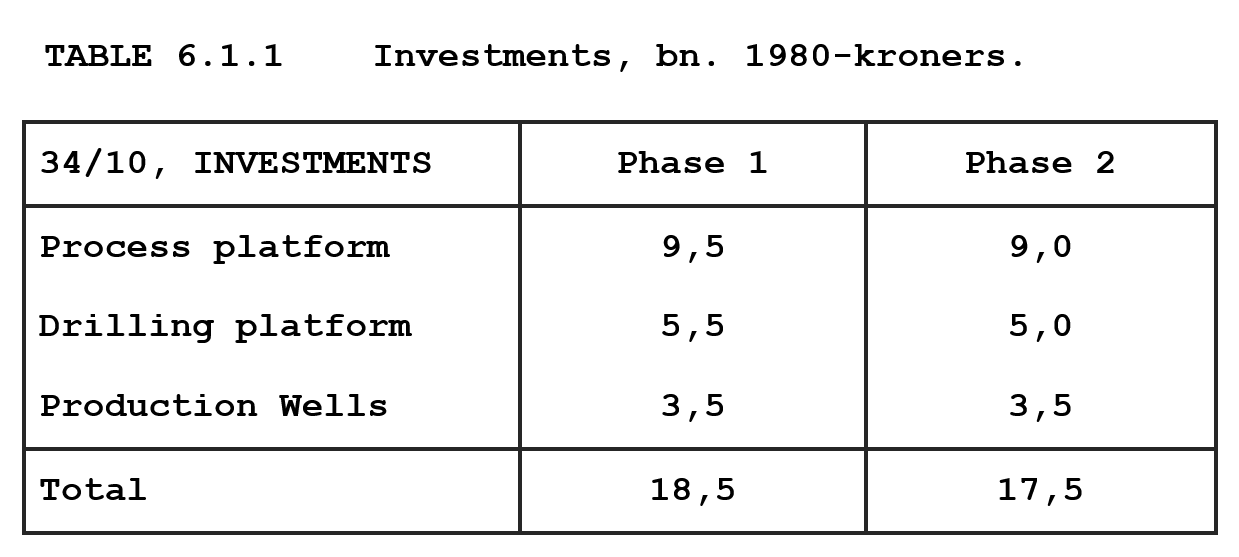
In its 1980 profitability study for Gullfaks, Statoil estimated that developing the field would cost a total of NOK 36 billion in 1980-value (NOK 167 billion in 2024-value) by 1996. The estimate was based on a plan to install two integrated processing and drilling platforms in concrete and two steel drilling platforms—all with accommodation modules.
More than half of the total investment costs would be tied to the two concrete processing platforms. The steel drilling platforms were estimated at NOK 10.5 billion combined, while production wells would add another NOK 7 billion. Operating costs were calculated separately.[REMOVE]Fotnote: Statoil ASA. (1980). Drivverdighetsstudie, bind I: Sammendrag og konklusjoner. S. 35 (Arkivreferanse: AV/SAST-A-101656/0001/D/Dc/L0831/0003). Sentralarkivet/Fjernarkivet, Saks- og korrespondansearkiv, konsernarkivet
Investments Over Time
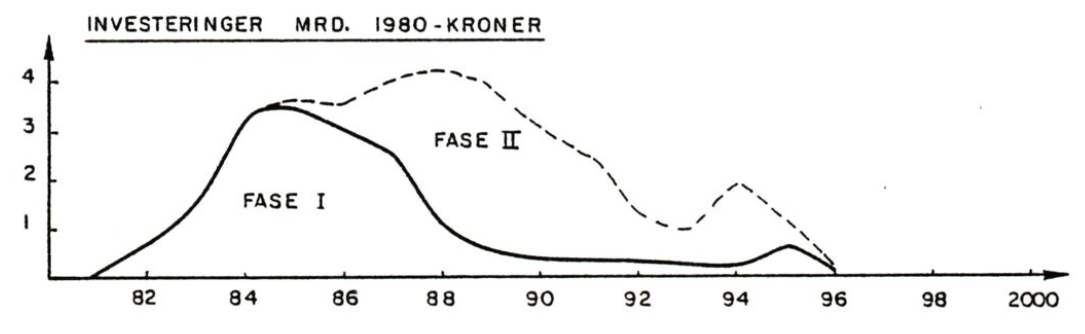
Statoil assumed in its profitability study that investments would be spread over 17 years. Field development was to be divided into two phases. Phase I covered the installation of Gullfaks A and B in the western part of the reservoir. Phase II was originally expected to include two additional platforms—Gullfaks C and D—in the east, one of which would be in concrete and one in steel. Later insights into the reservoir’s extent led to the scaling back of Phase II to just one platform: Gullfaks C.
The investment schedule projected peak spending between 1984 and 1989. If the project proceeded according to the 1980 plan, construction of Gullfaks C and D would overlap with the finalisation of Phase I during those years. Annual investments were expected to peak at more than NOK 4 billion in 1988.
Actual Investment Costs
Using historical investment data for the Gullfaks field from the Norwegian Offshore Directorate, we can compare the 1980 projections with reality. All values below are converted to 1980-NOK. Note that unlike the original projections, these figures include operating expenses—making the comparison somewhat less precise.
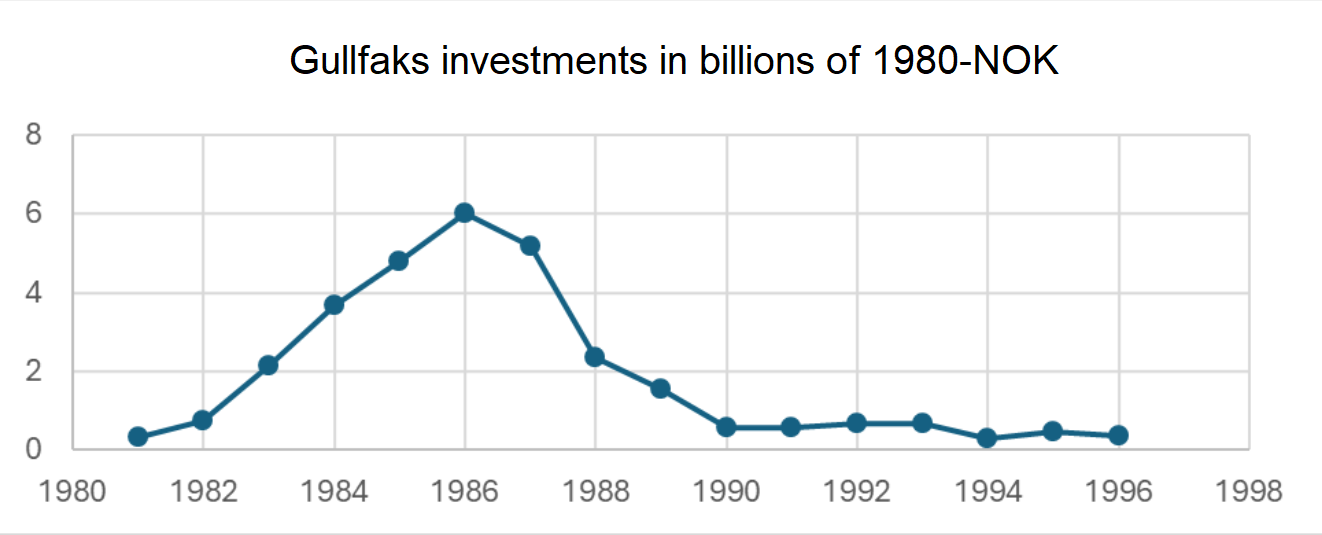
Between 1981 and 1996, it cost NOK 30.4 billion (in 1980 terms) to develop and operate Gullfaks. This is significantly lower than the NOK 36 billion projection (excluding operations). Actual investments peaked in 1986, then declined rapidly. From 1990 onwards, they remained below NOK 1 billion per year.
The 1980 profitability study had projected peak investment in 1988. However, actual spending that year was less than half the estimate—and about one-third of the amount spent in 1986, the actual peak year.
What Explains the Difference?
A major reason for the difference is that the directorate’s data include operational costs, which are substantial. In 1980, annual operating costs for Phase I alone were estimated at NOK 1.5 billion. The original projections, by contrast, only covered capital investments in platforms and wells. This suggests that the Gullfaks development stayed well below the original investment estimates.
The original plan was based on four platforms. Later, it turned out that the southeastern part of the reservoir was smaller than initially believed.[REMOVE]Fotnote: Lerøen, B.V. (2006). 34/10 Olje på norsk – en historie om dristighet. Statoil, s. 70. As a result, only the A, B, and C platforms were built. Gullfaks Phase II, approved in April 1986, consisted of a new drilling, processing, and accommodation platform in the eastern part of the reservoir.
Had Phase II also included the planned Gullfaks D platform, investment levels would have remained higher into the 1990s. Based on the 1980 projections, Gullfaks D alone would have cost NOK 5 billion.
Adding Gullfaks D to the project would have narrowed the gap between projections and actuals. All things considered, Statoil’s original estimate of the development costs for Gullfaks was relatively accurate.